
A parked truck still has a job
Hydraulics, tools and cab power belong in the vehicle specification. Measure the stationary duty before choosing how to supply it.
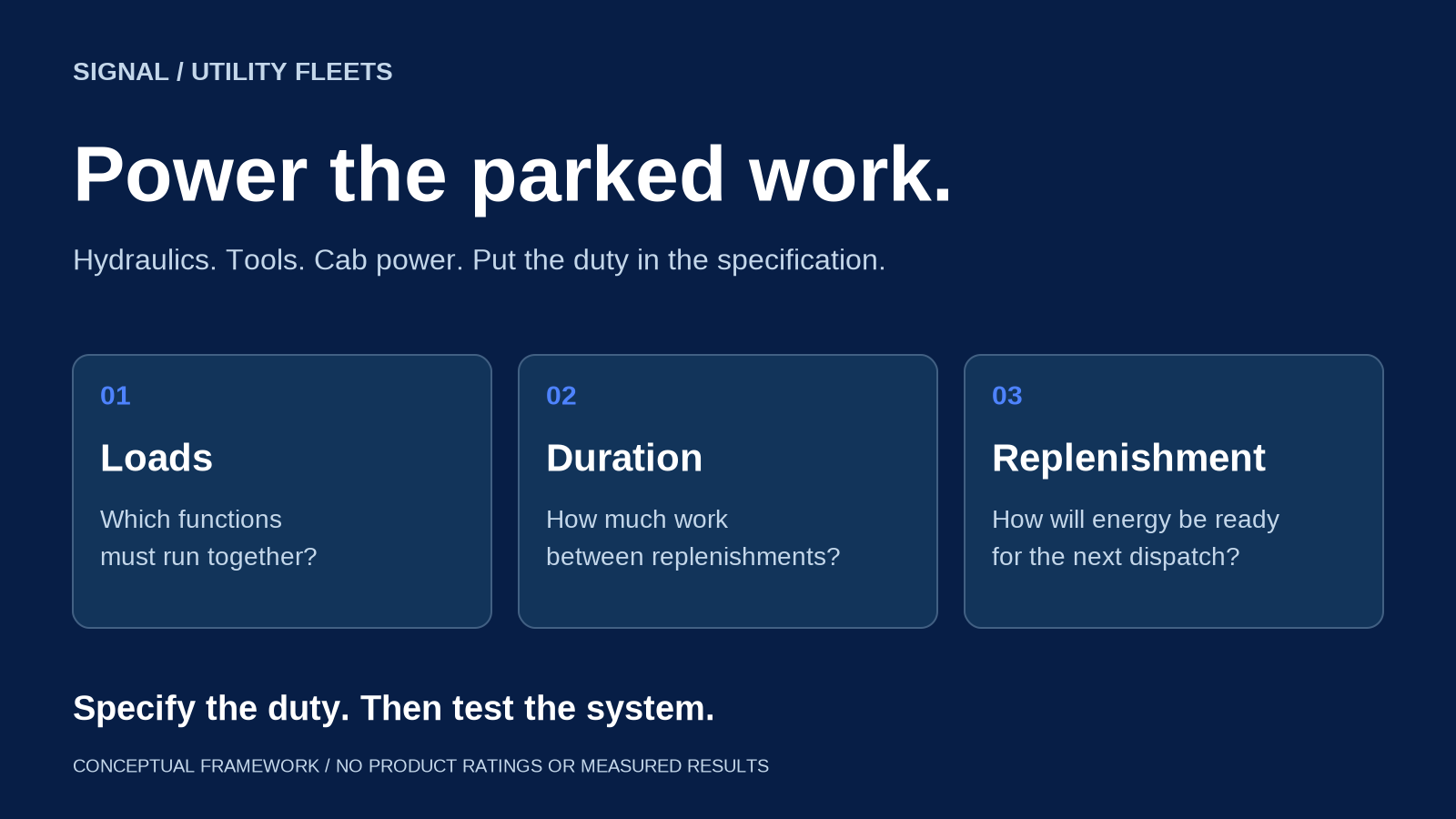
BLUF
Specify the work a truck must perform after it parks. Electric power take-off and auxiliary battery systems can support useful stationary duties while the main engine is off. For utility and field-service buyers, the decision starts with measured loads, operating time and replenishment—not the vehicle's mileage alone.
A bucket truck can travel a modest distance and then spend hours supporting the crew. That makes its parked work a product requirement worth testing on its own. The opportunity is concrete: supply the required functions with an energy arrangement that fits the job, the yard and the next dispatch.
Separate necessary work from unnecessary engine time
The US Department of Energy's Alternative Fuels Data Center distinguishes utility trucks that idle to power work equipment from vehicles using the engine for heating or cooling. Its medium-duty guidance identifies batteries, auxiliary power units and hydraulic storage among the options for stationary power. The appropriate approach depends on the duty. DOE's medium-duty idle-reduction guidance.
That distinction should carry into the fleet's data. We would separate travel, powered work, occupied waiting and unoccupied waiting. Record what is drawing power in each state. A stationary truck supplying a required function is doing something different from an empty truck running without a useful load.
An idle-hours total can flag a question. By itself, it cannot tell a buyer which hours can be removed without interrupting the work. Reducing an impressive number on a dashboard is a poor trade if the replacement arrangement cannot support the crew's actual assignment.
The odometer is an excellent record of travel. It is a remarkably incurious witness to everything that happens after parking.
The equipment already makes this distinction
Terex describes its WorkForce Power Take-Off by Viatec as a plug-in electric system supplying utility-truck hydraulics, including outriggers, boom, jib and winch. It also describes engine-off power for auxiliary applications such as lighting and cab heating and cooling, with factory-install and retrofit options. These are manufacturer descriptions; compatibility and the required configuration need confirmation for a particular vehicle. Terex WorkForce product overview.
This illustrates an important purchasing distinction: powering the work equipment electrically does not, by itself, make the truck's road propulsion electric. Buyers can examine stationary power as a defined part of the vehicle rather than treating the entire purchase as one indivisible technology decision.
For a fleet evaluation, we would ask the supplier to demonstrate the functions together in the required configuration. Can the hydraulic task run while the cab and essential accessories are supplied? Which combinations are supported? What happens as stored energy declines? The answers belong to the specific product and operating instructions; they should not be inferred from a broad engine-off claim.
Buy power and energy with different questions
Power describes the rate of energy delivery. Energy describes the quantity available over time. A battery's kilowatt-hour figure alone does not establish that its connected system can start or run every required tool, pump or accessory.
Consider a deliberately hypothetical stationary duty. Assume battery-side electrical demand averages 2 kilowatts for four hours, and another non-overlapping work period averages 4 kilowatts for half an hour. The energy used is 2 × 4 + 4 × 0.5 = 10 kilowatt-hours.
Those are invented inputs, not measurements of a utility fleet or ratings for the Terex or Altec products discussed here. Because the assumed demand is measured at the battery output, it already includes downstream conversion losses. It does not include an operating reserve, battery conditioning outside those measured periods, or energy needed for other duties. This is an energy tally, not a battery-sizing recommendation.
Even with that tally, the buyer still needs the instantaneous power requirement, any motor-starting demand, the permitted usable energy, temperature limits and the reserve needed for the assigned work. Nominal capacity and available working energy are different specifications. Ask the supplier to identify the measurement boundary and demonstrate the complete load profile.
| What the buyer needs to establish | Evidence to request |
|---|---|
| The equipment can perform its assigned task | Supported loads and combinations, observed during a representative demonstration |
| It can keep working for the required period | Measured energy use, task duration and remaining usable energy |
| It can be ready for the next assignment | Replenishment method, available connection time and verified departure readiness |
| The crew can handle a change of plan | Documented low-energy response, operator indications and approved fallback procedure |
A larger battery may address one constraint and introduce others. Include installed weight, usable payload, packaging, service access and total installed cost in the comparison. Specify the complete working vehicle with its equipment and crew load.
Prove the charging window at the actual yard
DOE's guidance notes that a stationary-power battery can be charged overnight and replenished during the day when needed. That is a useful starting possibility, not a guarantee that a particular yard or schedule will support it. DOE's battery and auxiliary-power discussion.
For the trial, record arrival condition, the connection actually available, when charging begins and the energy state before dispatch. A vehicle parked for ten hours does not necessarily receive ten hours of charging. Someone has to connect it, the supply has to be available, and the equipment has to accept the charge.
Include the awkward assignment in the evaluation: a late return followed by an early departure, or an extended job with fewer opportunities to replenish. Use the manufacturer's approved procedures to establish the response. A low-energy plan should exist before the crew meets it during a callout.
This is also where economics become credible. Compare avoided main-engine fuel and evidenced maintenance effects with purchased electricity, equipment cost, installation, support and any operational changes. Retain the same work output in the comparison. Do not book a full fuel saving while ignoring the energy used to recharge the system.
Make utilization part of the acceptance test
Altec says its Insights for JEMS dashboard can compare anti-idle hours with total jobsite hours, show utilization across assets and provide diagnostic and battery or override-event information. That is evidence of the supplier's measurement offering, rather than independent proof of a particular fleet's savings. Altec Insights for JEMS.
We would use that kind of information to understand why the equipment is or is not being used. Was it charged? Was the assignment within its supported scope? Did the operator need a different mode? Was there a fault? A system that works in a demonstration but is routinely unavailable or bypassed needs investigation before the fleet expands the order.
Agree acceptance criteria with operations, maintenance and procurement before the trial. Include completion of the required task, supported simultaneous loads, energy remaining, readiness for the next dispatch and understandable exception handling. Compare representative assignments and weather conditions; record unsuccessful days with the same care as successful ones.
For investors, our reading is that this creates an opportunity for disciplined vehicle integration: understanding a recurring duty, matching equipment to it and making deployment supportable. The commercial test is whether customers repeatedly obtain useful work at an acceptable total cost. A component specification starts that conversation; operating evidence earns the next order.
As VoltSmiths develops industrial work vehicles, the stationary job deserves a place beside the driving job. Understanding what the crew needs after parking can reveal a practical improvement worth building—and a clear way to test whether it helped.