
Buy connectivity for the work.
Satellite links can bring the office to a remote machine. Fleet buyers still need to distinguish job data, precision positioning and machine control.
BLUF
A remote machine needs the right connection for the job it is doing. Satellite internet can extend the reach of plans, work records and service expertise into areas with weak cellular coverage. The buying decision gets sharper when a fleet separates those exchanges from precision positioning and the connections a control system requires to operate.
For agricultural contractors and equipment managers, that means specifying the completed work exchange before comparing terminals or subscription prices. Can the next assignment reach the machine? Can the supervisor confirm it arrived? What remains available if a required connection disappears? A signal-strength icon cannot answer all three.
Bring the office to the field
John Deere's Australian JDLink Boost documentation describes a concrete data path: the machine's JDLink modem uses Wi-Fi from a Starlink terminal to reach the cloud, making machine and agronomic information available in Operations Center. Messages going to the machine follow the reverse path. The product page lists transfers of plans, guidance lines, prescriptions and work records, alongside remote monitoring and support. Regional features and availability require confirmation with the dealer. John Deere's JDLink Boost product description.
That is useful infrastructure for work already happening. Imagine a hypothetical agricultural contractor whose office needs to deliver a revised assignment to a machine beyond dependable cellular coverage. The operational goal is an identified machine receiving the correct revision in time to use it. Whether the terminal can stream a movie is a less urgent question.
There is field experience behind the proposition. In a July 17, 2025 release, Deere reported testing JDLink Boost during seeding, spraying and cotton picking in Queensland and New South Wales. The company described access to Operations Center and visibility of connected machines during those trials. This is a manufacturer account of field testing; it does not establish a universal uptime figure or independently measured savings. Deere's Australian field report.
For a buyer, the opportunity is a shorter distance between the person making the plan and the person carrying it out. Prove that exchange on the equipment and ground where it matters.
Separate the three questions
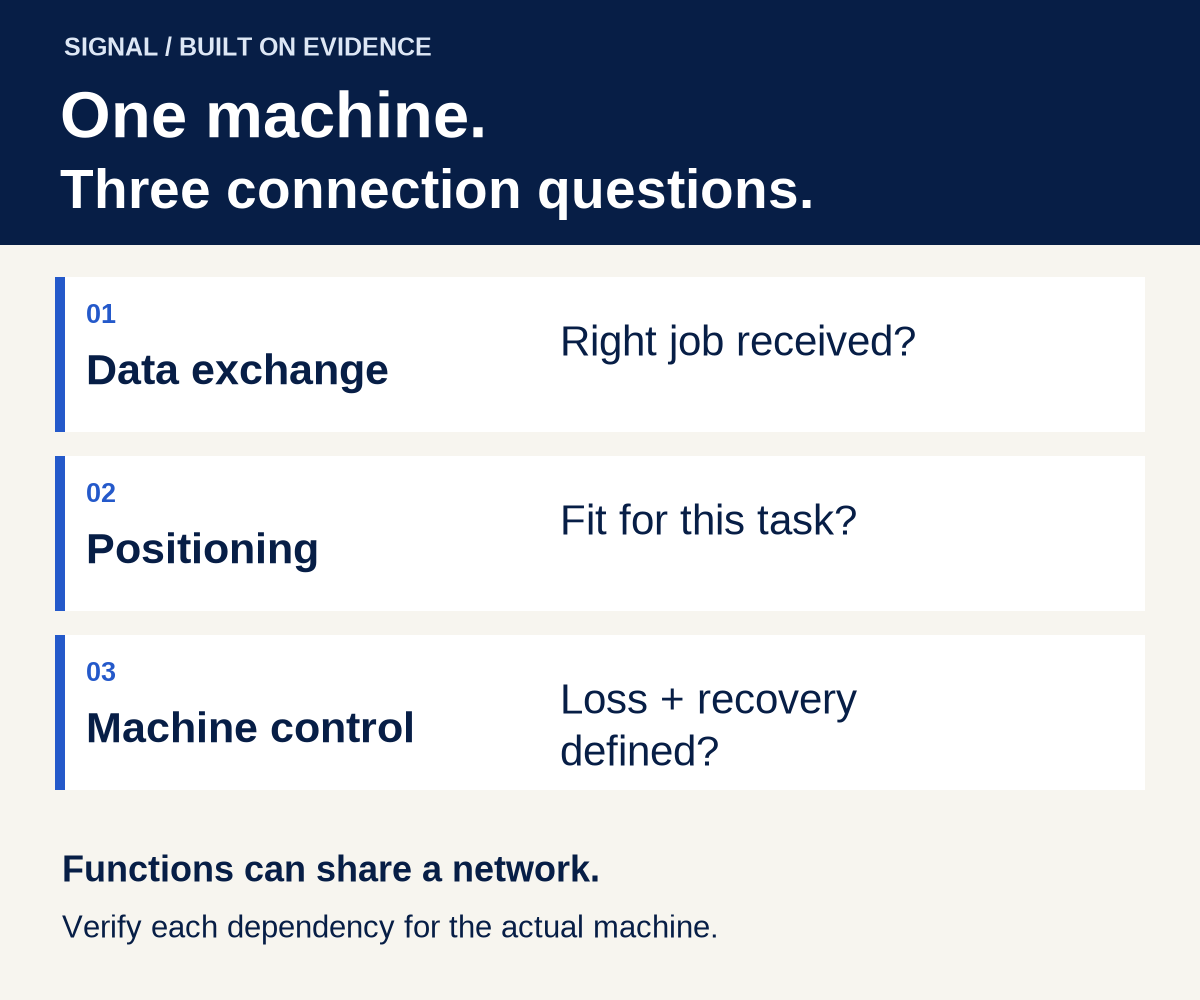
We would divide the specification by function. These functions may share communications infrastructure, but each needs its own evidence.
| Function | Customer question | Evidence to request |
|---|---|---|
| Business and job data | Did the correct information reach the right machine or office? | Supported transfer, revision identity, acknowledgement and delivery time |
| Precision positioning | Is the reported position suitable for this particular task? | Receiver configuration, correction mode, estimated precision and applicable limits |
| Machine control | What does the system do when a required connection is lost? | Product-specific operating response, local authority and recovery procedure |
This is our purchasing framework, not a list of guaranteed features in the cited products. Ask how the supplier implements each requirement and where a manual confirmation remains necessary.
The distinction matters because broadband access is not, by itself, evidence of positioning accuracy. Nor does completing a file transfer demonstrate that a vehicle or attachment can operate autonomously. Those conclusions require the relevant system's own operating evidence.
A second satellite service may have a different job
Precision positioning provides a useful example. Real-time kinematic positioning, usually shortened to RTK, uses corrections alongside satellite observations. Trimble's Alloy receiver help explains that ordinary RTK corrections can arrive through radio or internet connections. Its xFill service uses a separate satellite correction link to bridge an interruption in the primary correction stream. Trimble's xFill explanation.
The same documentation ties performance to satellite visibility, geometry and the local signal environment. It describes increasing estimated error during the outage and point-measurement limits based on the user's specified tolerance. These are conditions for that documented positioning service, not a promise that any machine can keep working through any communications loss.
Deere's StarFire RTK Extend help makes the configuration issue equally tangible: supported behavior differs by receiver family, and availability depends on conditions such as enabling the feature and prior reception of the required signal. The help also describes transitions to other positioning modes when the extension expires. Deere's RTK Extend documentation.
Our conclusion is straightforward: name the failed link before buying a backup. An internet outage, a missing correction stream and obstructed satellite observations are different problems. Request the applicable instructions for the actual receiver, software and task. A feature called fallback still needs a description of what it preserves, for how long, and under which conditions.
Trial the assignment, not just the connection
Start with one recurring exchange that is costly to miss. For the hypothetical contractor, it might be delivery of an updated field assignment followed by a completion record. Agree the required content, permitted delay and confirmation method with the supplier and crew before the trial.
Trace a representative job through the supported workflow. Record when the office sends it, which revision the machine receives, how the operator knows it is current and when the office receives the resulting work record. Include ordinary work locations and operating periods. The useful result is a completed exchange that the crew can explain.
Then review the degraded case in a supplier-approved training environment or documented walkthrough. Establish what is stored locally, what waits for reconnection, how stale information is identified and who resolves conflicting revisions. These are questions to demonstrate, not assumptions that every product buffers or reconciles records automatically. Keep any loss-of-link tests within the supplier's approved procedure; do not improvise interruptions on working machinery.
For control-dependent functions, request a separate demonstration of the specified response and recovery. Determine what must stop, what may continue and who authorizes a return to operation. The job-data trial does not settle those requirements.
Pay for a result the crew can recognize
Evaluate successful on-time exchanges, failed transfers, time spent chasing confirmations and extra travel attributable to missing information. Compare similar jobs and include unsuccessful attempts. A higher data rate can be useful, but its business value depends on the workflow it improves.
Include installation, compatible hardware, subscriptions, support and administration in the comparison. Ask who owns the fault when the office application, modem and satellite service each appear healthy but the assignment still has not arrived. Clear support responsibility belongs in the purchase alongside the equipment.
For investors assessing industrial technology, this is a practical source of value: making an existing operation more dependable without requiring the customer to replace its entire fleet. For VoltSmiths, it reinforces a design question as work vehicles develop: which information must reach the crew, machine or installed equipment, and what constitutes a completed exchange? Better connectivity earns its place when the work gets easier to organize and deliver.
Sources and further reading
- John Deere Australia — JDLink Boost: data path, supported exchanges and regional qualification
- John Deere — Australian field-testing account, July 17, 2025
- Trimble Alloy receiver help — xFill operation and positioning limitations
- John Deere display help — StarFire RTK Extend and receiver-specific conditions