
Getting the robot to the work.
Remote demolition can put useful power into difficult spaces. The commercial advantage depends on access, working room and a site ready to support the machine.
BLUF
Remote demolition equipment can put substantial working power into places that are difficult to reach. For plant-maintenance teams and demolition contractors, the opportunity depends on getting the complete machine package into position, supporting it there and getting it out again. Evaluate that deployment alongside the breaking or stripping task before committing to a purchase or rental.
The useful detail was the lift
A cement-plant example makes the point. In an October 16, 2020 account, Brokk described a custom remote-controlled Descaler used at LafargeHolcim's Cauldon facility in the United Kingdom. The machine worked through openings into the preheater equipment, using a telescopic arm to remove accumulated material.
The site had prepared six access hatches before the robot arrived in 2019. Crane access was constrained, so Cauldon checked that the machine could fit in an internal lift and travel to the required level. It could then move toward the hatch under its own power. Brokk's Cauldon case study.
That is a historical supplier account about a custom installation, not evidence that the same arrangement suits another plant. Its practical lesson is valuable: the access work happened before the maintenance machine arrived. Our buying conclusion is to put that enabling work in the proposal, with an owner and a completion date.
A narrow machine still needs a working place
Compact equipment makes more jobs worth investigating. Brokk's current 70+ specification lists a minimum width of 597 mm, or 23.5 inches, and a machine weight of 560 kg, or 1,235 pounds. The weight explicitly excludes the attachment and extra equipment. The page also says load and stability diagrams are available on request. Brokk 70+ specifications.
Those are useful starting points for a site survey. They do not establish the clearance, floor capacity or working arrangement for a particular job. A minimum width describes one dimension of the machine; the proposed attachment, movement and operating position still need to be considered.
We would ask the supplier to show two arrangements on the site plan: how the configured machine travels to the work, and how it occupies the space while working. Include the turns, thresholds and staging areas on the route. Identify the actual machine, tool and auxiliary equipment in the load information supplied for the site's structural assessment.
That assessment belongs with qualified people using the real configuration and building conditions. The headline weight is not a floor approval. Nor does a machine fitting through a doorway establish that the crew can use it productively on the other side. Doorways have an admirable indifference to the sales presentation.
Wireless control still needs a power plan
Husqvarna's international DXR 95 page puts wireless remote control and a three-phase 400–480 V electrical supply in the same specification. It lists a 9.8 kW motor and a weight of 589 kg, or 1,299 pounds, excluding the attachment. These are published product details; the ordered variant and its instructions must establish the exact requirements for a site. Husqvarna DXR 95 overview.
For procurement, the distinction is straightforward: the control link and the machine's energy supply are separate questions. A wireless handset does not establish battery-powered operation. The same page describes an operator using a remote control, including a switch between transport and work modes. These examples demonstrate remote operation; they do not demonstrate an unattended autonomous demolition service.
Before mobilization, we would have the responsible electrical specialist and equipment supplier agree the supply arrangement, connection and cable routing for the selected configuration. If a generator is proposed, obtain a specific sizing and suitability decision. A motor-power figure alone is not a complete generator specification.
Also identify any water, extraction or other supporting equipment required by the approved work method. The package should reach the job together. A machine waiting for its supporting services is an expensive way to reserve floor space.
Put the route into the quotation
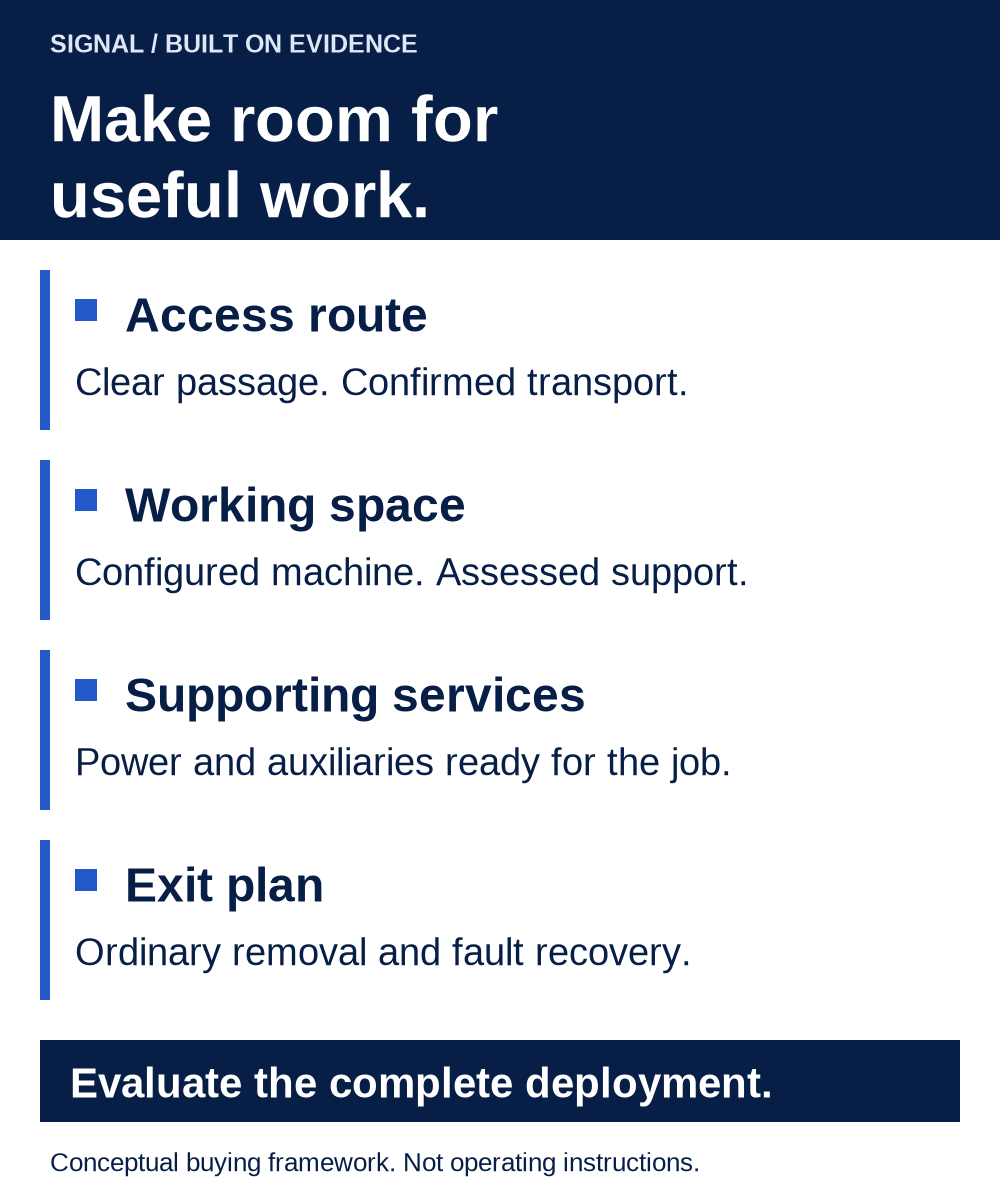
Our proposed procurement check is a short deployment sheet shared by the contractor, equipment supplier and facility team:
| Part of the job | Decision to settle | Evidence for the proposal |
|---|---|---|
| Arrival and entry | How does the complete package reach the work area? | Surveyed route and confirmed transport arrangement |
| Working position | Can the configured equipment do the task in that space? | Supplier layout and site assessment of loads and clearances |
| Supporting services | What must be ready before work starts? | Agreed power and auxiliary-service plan, with owners |
| Exit and recovery | How will equipment and removed material leave? | Planned removal route and approved response to a disabled machine |
This is a commercial planning aid, not an operating method or structural approval. The equipment instructions, trained operators and site-specific work controls remain essential. Remote operation changes where the operator controls the machine; it does not remove the need to manage the work area and everyone affected by it.
The exit deserves as much attention as entry. In the proposal, distinguish ordinary removal from recovery after a fault. Name who provides the recovery method and equipment. Check whether changes made during the job could affect the route out, and allocate responsibility for removing debris and restoring temporary access arrangements.
Price the next visit as well as the first
A contractor comparing methods should separate one-time enabling work from costs that recur on every visit. A prepared opening or agreed access arrangement may be useful again, subject to inspection and any changed conditions. Transport, setup, trained operating staff, services and removal still need a price for each assignment.
For a representative trial, we would record elapsed time from arrival through positioning, service connection, the agreed task and removal. Record the accepted work separately from time spent mobilizing. If one method breaks material faster but takes longer to establish on site, the customer needs both numbers.
That information supports a more useful purchase-or-rental decision. A facility with repeated similar work may value a repeatable deployment package. A contractor facing different buildings may value equipment flexibility and site-survey support. Neither case is settled by the machine's purchase price or a supplier's fastest demonstration.
For VoltSmiths, this is a useful lesson as we pursue work capabilities beyond driving. The vehicle and installed equipment must fit the customer's place of work, including the practical arrangements that let the task begin and end. That is part of designing a product an industrial customer can put to use.