
Give the freed hours a job.
Robotic cleaning can create capacity inside an industrial facility. The buying case improves when that time has a useful assignment and a result the team can verify.
BLUF
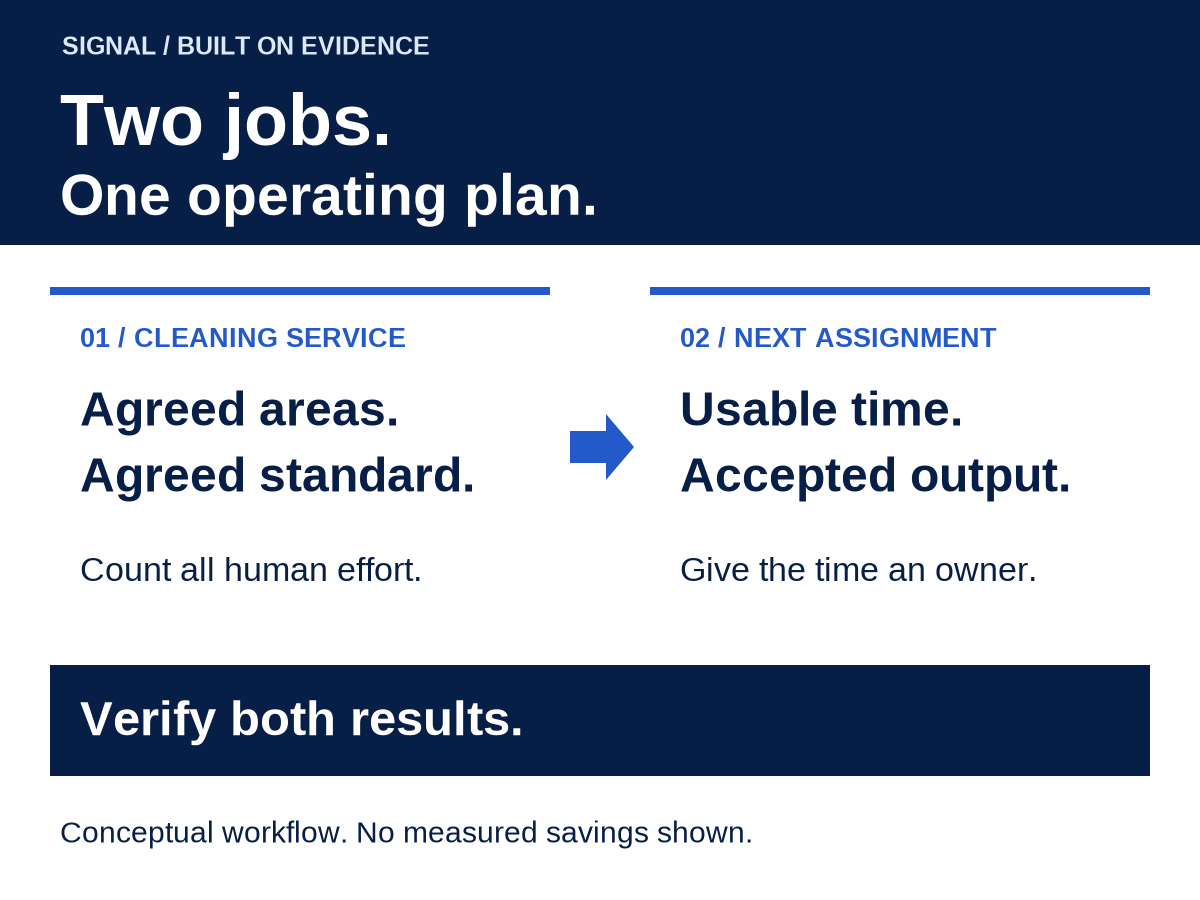
Robotic floor cleaning can give a warehouse something more useful than a busy robot: staff time for another job. Supplier accounts from industrial facilities show that opportunity in practice. Before buying, name the work that will receive the time, then verify that the cleaning service and the second assignment both get done.
An operator moved to packaging
Tennant's account of CNH Industrial's parts distribution center in Lebanon, Indiana, describes floor cleaning that occupied more than 40 hours of an employee's week. The site explored robotic cleaning in mid-2022 and purchased a T16AMR. Tennant reports that the employee who operated the previous ride-on scrubber was reassigned to the packaging area. Tennant's CNH case study.
The same account describes work before the deployment: planning routes and asking the team to keep items in their proper places and aisles clear. Tennant says those measures reduced machine assists. These are supplier-reported experiences at one facility, not an independently measured return or a staffing promise for another warehouse.
The reassignment is the commercially interesting part. Someone identified another place where the employee's time could be useful. A buyer can test that idea without assuming the same machine, building or result.
A spreadsheet can free an hour. The shift supervisor still has to put it to work.
Count the people around the machine
Autonomous runtime and recovered labor are different measurements. The robot may spend an hour on a route while staff prepare another area, respond to an interruption or care for the equipment. Those activities belong in the operating plan and in the comparison with the old cleaning method.
Tennant's March 2024 European T16AMR manual specifies indoor hard-surface use, trained operators and approved environments. It retains operator responsibility for monitoring safe operation. Its pre-operation checklist covers items including battery condition, brushes, squeegees and sensors; later sections address assist messages and daily recovery-tank cleaning. These are requirements for that documented configuration, not a universal description of every cleaning robot. T16AMR manual, pages 3, 28–29, 56 and 60.
Our proposed evaluation counts all human work needed to deliver the agreed cleaning service: preparation, machine handling, required monitoring, assists, manual finishing, inspection and care. Count time contributed by other employees too. Moving a task from the cleaner to a maintenance technician does not make it disappear.
Keep initial training and route setup visible as introduction costs, and track the recurring work separately. That lets the buyer see whether a demanding first week becomes a stable routine. Use the actual model's instructions and site requirements to establish responsibilities; a labor estimate does not determine how closely a machine must be supervised.
Three clocks, three different answers
A useful trial should distinguish these measures:
| Measure | What it tells the buyer | What it cannot establish alone |
|---|---|---|
| Autonomous runtime | How long the machine operated autonomously | How much staff time became available |
| Human cleaning effort | Total person-hours needed for the agreed service | Whether remaining time fits another assignment |
| Completed second-job work | What the team accomplished with the usable time | Whether the cleaning result remained acceptable |
Consider an illustrative comparison, not a Tennant result. Suppose the same cleaning service previously required three person-hours per shift. A trial records 45 minutes of total human effort around the robotic and manual work. The arithmetic difference is two hours and 15 minutes. Across five comparable shifts, that is 11 hours and 15 minutes of potential capacity.
Potential matters. Several short intervals interrupted by assists may be less useful for a continuous packaging assignment than a predictable block. The employee also needs the training, equipment and access required for that second job. Record when the time becomes available and whether the proposed assignment can actually fit.
The comparison must hold the cleaning scope, frequency and acceptance standard steady. If the robot cleans more often, record that as additional service rather than calling every extra machine hour a labor saving. If the baseline omitted machine care, put that work back into both sides of the comparison.
Let the building choose the division of work
A mixed approach can be a deliberate operating model. In its Limcamar case study, Tennant describes logistics cleaning that assigns broad, continuous areas to autonomous routes and smaller, intricate areas to conventional methods. The account also describes initial supplier training reinforced by the cleaning contractor. Its stated reporting period is December 25, 2025, through January 25, 2026; it is a bounded supplier account, not a current performance guarantee. Tennant's Limcamar case study.
For a warehouse trial, we would select areas where the proposed division of work is clear. Record which cleaning duties remain manual, who responds to the machine and what happens when the usual responder is absent. Coordinate the cleaning window with the operation so that creating a clear route does not quietly add work or delays elsewhere.
The aim is a useful service arrangement that the next shift can repeat. Maximizing the autonomous percentage is only valuable if the whole arrangement improves.
Give the next assignment its own evidence
Brain Corp's March 2022 deployment guidance describes reporting such as coverage, routes run, autonomous versus manual usage and heat maps. It recommends reviewing those records to improve deployment and operating times. Those reports are useful evidence of machine activity. Brain Corp's deployment guidance.
Our recommendation is to pair the activity record with two human decisions. First, the responsible supervisor checks whether the agreed cleaning result was achieved, including areas finished manually. Second, the manager of the receiving work records what the reassigned time produced. A route map is not, by itself, an inspection of floor condition or proof that another department gained capacity.
The second assignment might be packaging a scheduled batch, completing a maintenance task or resolving a defined backlog. Choose it with the people doing the work. Set a completion criterion and preserve the actual result, including days when the opportunity did not materialize.
For the commercial case, distinguish added output or service capacity from a reduction in spending. Put the machine, subscription, service, consumables and introduction costs alongside the observed benefit. An employee doing more valuable work is a different outcome from a lower payroll bill; do not count both automatically.
This is the industrial-autonomy opportunity VoltSmiths wants to pursue beyond driving: a vehicle and its working equipment taking on a useful task within an operation that can use the result. The next job deserves a place in the design brief. That is where recovered time starts becoming customer value.