
Know what left the hopper.
Connected spreaders can make winter material use easier to manage. Buyers need calibration, clear reporting modes and a material account they can reconcile.
BLUF
Winter fleets should be able to explain every material total they use to make a buying decision. Connected spreaders can link application records to routes and locations. The next step is making those records dependable enough to guide purchasing, maintenance and winter operations.
For municipal and contractor fleets, that starts with three questions: how was the quantity established, which equipment and material were calibrated together, and does the record reconcile with what was loaded and returned? Those answers turn an attractive report into a useful management tool.
Start with what the number means
FORCE America describes its SSC6100 spreader controller as integrating material-application and location reporting through PreCise MRM. Its product page also lists material-specific settings and calibration import/export. That is a concrete example of installed equipment becoming part of a connected operating record. It is a manufacturer description, not an independent accuracy test. SSC6100 product information.
The detail worth reading is in the calibration manual. For the Gen 5 controller, Rev M covering firmware 0.86, the Open Loop Totals setting enables estimated granular-material totals for data and event logging when Loop Mode is explicitly set to Open. The setting defaults to disabled. The manual says it does not apply when the controller switches to open loop because of a feedback error. Calibration manual, printed page 9.
That qualification matters. A buyer cannot assume the meaning or continuity of a total from its column heading. Ask the supplier to identify which quantities are directly measured, which are calculated from calibration and operating signals, and which may be unavailable in particular modes. A feedback signal alone does not establish that a displayed mass was independently weighed.
This is also a reporting requirement: can the supervisor distinguish a valid zero from a missing record? Can an estimated interval be identified? Can a report explain a mode change without someone reconstructing the night from memory?
Those are questions for the exact configuration under consideration. They are not claims that every controller behaves like this example, or that the named product lacks a particular reporting feature.
Keep calibration attached to the equipment
Minnesota's January 2022 Snow and Ice Control Handbook recommends yearly calibration or verification, calibration for each truck and material, and renewed attention after changes such as hydraulic adjustments, auger wear or replacement, and a new material. It directs users to manufacturer instructions and supplier training. This is practical Minnesota guidance, not a universal maintenance interval or a substitute for the equipment's own requirements. Handbook, printed page 4.
The purchasing implication is straightforward: calibration support belongs in the delivery plan. Specify who performs it, what record the fleet receives, how a replacement component affects that record, and who helps when a verification result is outside the agreed tolerance.
For a fleet using removable spreaders, our recommendation is to retain the truck, spreader, material and configuration identities together. Record the date and verification result as well. A file labeled “winter settings” is a poor explanation when two bodies have traded trucks.
A controller that is easy to configure creates an opportunity for consistency across a fleet. Maintaining the connection between a setting and the physical equipment is what makes that consistency meaningful.
Close one material account
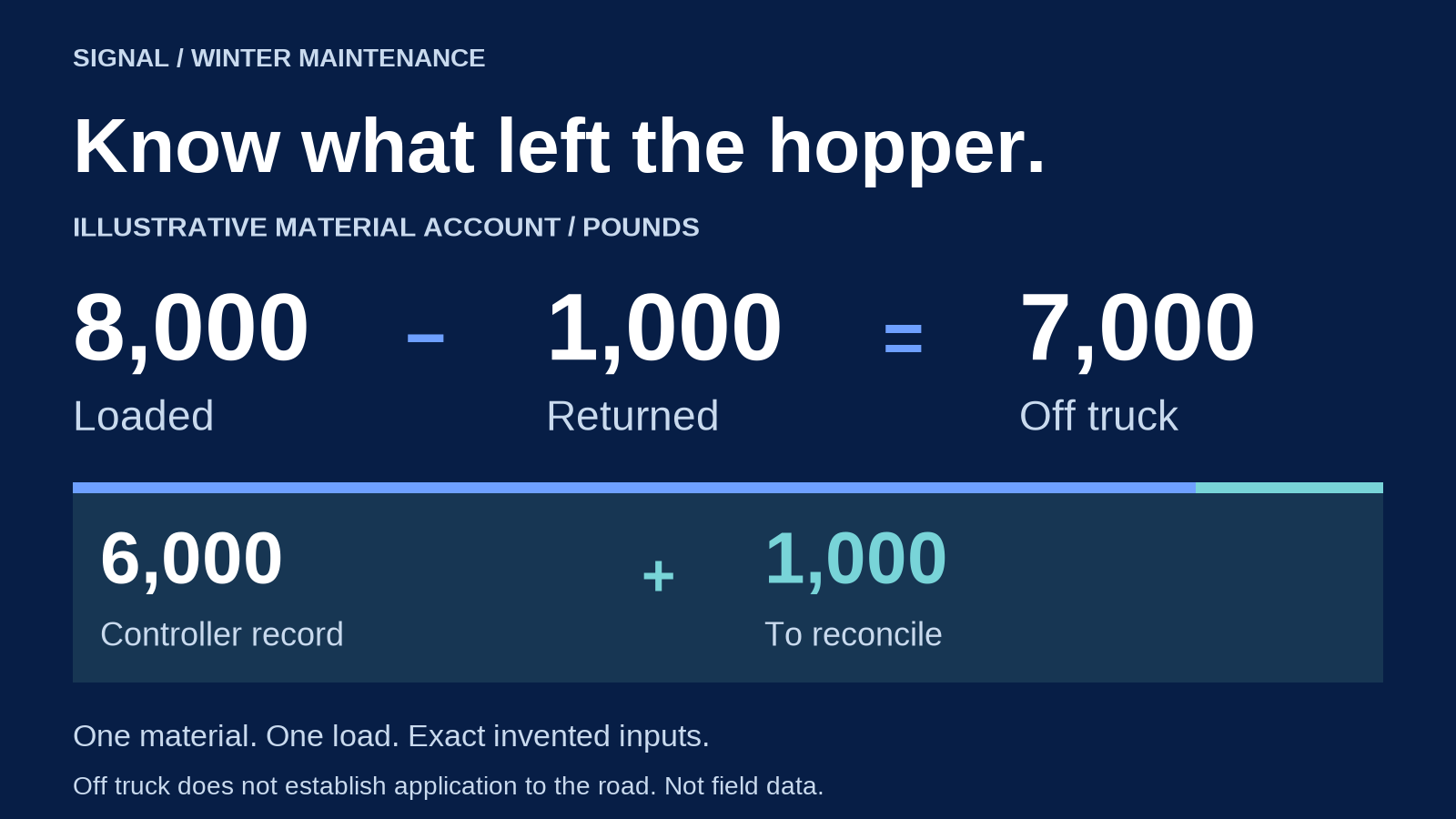
Consider a deliberately simplified example. These are invented quantities, not a trial, equipment capacity or recommended load. Assume an empty hopper receives one weighed load of a single granular material, there are no additional loads or transfers in, and the remaining material is weighed on return.
The starting load is 8,000 pounds. The return is 1,000 pounds. The difference is 7,000 pounds no longer on the truck.
Now suppose the controller record totals 6,000 pounds for the same period. There is a 1,000-pound difference to reconcile.
That difference is a question. It does not prove overapplication, waste, a faulty controller or operator misconduct. Nor does subtracting the return prove that all 7,000 pounds reached the intended road surface.
First check the boundaries of the account: the material, truck, time window, units and every loading or unloading event. Then examine the weighing records, calibration, operating modes and gaps in the log. Material spilled or discharged elsewhere would also need to be accounted for. The permitted measurement uncertainty belongs in the comparison; the example assumes exact inputs only to make the arithmetic clear.
Our recommendation is to demonstrate that complete account during evaluation, using an agreed, controlled verification process. Keep the two records independent enough to challenge each other. Copying the controller total into a load sheet and then congratulating the two for agreeing would be efficient paperwork. It would teach the fleet very little.
Buy an explanation for the exceptions
A normal run is only part of a useful supplier demonstration. Ask to see a completed material record, an estimated interval where supported, an interrupted record and the reporting consequences of a relevant equipment fault. Use manufacturer-approved demonstrations or simulation for abnormal conditions, with qualified personnel following the equipment instructions.
The question is what the fleet receives afterward. Does the export retain units, time and equipment identity? Does it preserve the status needed to interpret a quantity? Can the original record be retained when someone corrects an assignment or adds an explanation?
Define a simple ownership path. Operations checks the route and load records. Maintenance checks the equipment and calibration history. The supplier explains controller behavior and supports an unresolved discrepancy. A variance should arrive with enough context for the responsible person to investigate it.
Include the cost of maintaining that capability. FORCE America's manual, for example, states that over-the-air event logging to PreCise MRM requires a subscription. Buyers should confirm the complete quoted configuration, service terms, training and ongoing support rather than treating connectivity as a one-time hardware line. Calibration manual, printed page 5.
Make the winter result count
A reconciled material account establishes a better basis for evaluation. Service performance still matters.
The Minnesota Pollution Control Agency's 2023 Smart Salting for Roads Manual recommends evaluating work after storms and using documentation to understand equipment, materials, cycle times and application rates across events and seasons. That gives the data a purpose beyond producing a tidy total. After the storm, printed page 55.
Our buying test would combine trustworthy material records with the fleet's service objectives, route demands and weather conditions. Lower recorded consumption is not automatically better performance. A claimed improvement needs a comparable operating context and an explanation of what changed, including measurement changes.
For suppliers and investors, there is a practical business opportunity here: equipment that can be commissioned, checked and supported as a repeatable service. The customer buys confidence in decisions as well as control of the spreader. That confidence needs people, records and support that remain useful through component changes and successive winters.
For VoltSmiths, this is part of the longer-range ambition to extend autonomy into the work vehicles perform. The work includes knowing what happened, recognizing uncertainty and making recovery manageable. A machine that can explain its material account gives its operator and owner something solid to build on.
Sources and further reading
- FORCE America — SSC6100 product information and current technical resources
- FORCE America — Gen 5 calibration manual, Rev M, firmware 0.86; printed pages 5 and 9
- MnDOT / Minnesota Local Road Research Board — Snow and Ice Control Handbook, January 2022; printed page 4
- Minnesota Pollution Control Agency — Smart Salting for Roads Manual, 2023; printed page 55