
Make the savings survive next season.
Precision spraying can reduce input use. The buying case also needs weed control, complete costs and a field worth returning to.
BLUF
Precision spraying offers a compelling kind of automation: spend less input on places that do not need it while completing the intended job. For growers and custom applicators, the purchase should be judged on weed control and complete operating cost across seasons. Research on targeted spraying shows why the lowest consumption figure alone cannot settle that decision.
The field keeps the receipt
A sprayer can record a successful application long before the grower knows its full value. The chemical bill arrives quickly. Evidence about missed weeds and the next season's management burden takes longer.
That makes precision spraying an unusually useful example for anyone buying industrial automation. The machine makes many small decisions about where to act. The business needs those decisions to add up to a satisfactory result, including consequences that appear after the demonstration has ended.
A 2026 Weed Technology paper by Tristen Avent and colleagues reports a 2022–2024 soybean experiment in Keiser, Arkansas, comparing broadcast application with the highest and lowest detection sensitivities of See & Spray technology. All treatments began with a broadcast preemergence residual herbicide; the later targeted treatments included both foliar-active and residual herbicides. Targeting produced economic benefits in the study. The highest sensitivity maintained comparable weed control, while the lowest allowed more escapes and an increased weed seedbank over time. Avent and colleagues, study and practical implications.
The result is encouraging and conditional. It supports a useful application of automation, with settings and the treatment program affecting the outcome. The researchers caution against extending the findings to all production areas or sprayer setups. Blue River Technology, a Deere company, and the United Soybean Board funded the work; that relationship belongs beside the findings. The paper reports field research, not a guarantee for a current commercial configuration.
For the buyer, the practical question is whether a proposed saving persists after the whole job is counted. A weed left behind does not care how attractive the dashboard looked.
Specify the treatment program with the machine
The University of Arkansas's March 2025 account of the research explains the equipment distinction. Its experimental machine could operate with separate tanks for broadcast residual treatment and targeted spraying, but the trial simulated a single-tank approach. The account describes how delivering residual and targeted treatments with a single-tank system can require separate passes. These are details of that research and the configurations discussed at the time, not a current compatibility chart. University of Arkansas research account.
That distinction belongs in the quote. Ask the supplier and the grower's agronomist to explain how the proposed machine will execute the approved crop-protection program: what is broadcast, what is targeted, what requires another pass and which duties remain with the operator. The equipment purchase should fit that program.
For a custom applicator, this also affects the service being sold. Define whether the price covers a particular pass, a complete agreed program or additional follow-up work. A customer and contractor can both be pleased with a lower-volume pass while carrying very different assumptions about who pays for the next visit.
Keep application rates, products, timing and operating settings with the qualified agronomic team, applicable labels and equipment instructions. This is a purchasing evaluation, not a chemical recommendation.
Read the unit behind the savings claim
John Deere's current US getting-started page explicitly defines savings in its Application Savings Guarantee as reduced application volume, excluding other costs and expenses. It says results depend on weed pressure, crop, settings and environmental conditions. The same page presents usage-based and annual licensing choices. Those are supplier terms to confirm for the machine and season being quoted. Deere's licensing overview and savings qualifications.
That gives procurement three separate quantities to keep straight: the reduction in material applied, the reduction in the customer's expense, and the cost of obtaining that reduction. They are related, but they are not interchangeable.
Our proposed comparison would use the same field area, crop-protection objective and evaluation period. Show the baseline program and proposed program side by side. Include equipment ownership or upgrade cost, licensing, material, labor, tendering, extra passes, maintenance and follow-up. Credit only benefits supported by the comparison.
An annual license should be assessed against realistic eligible work, not every acre the business happens to farm. A usage-based offer needs its billing unit and exclusions explained. Ask how the supplier's report reconciles to the invoice and to the actual work record. A percentage is a starting point; the purchase needs a denominator and a bill.
Give the trial three reporting dates
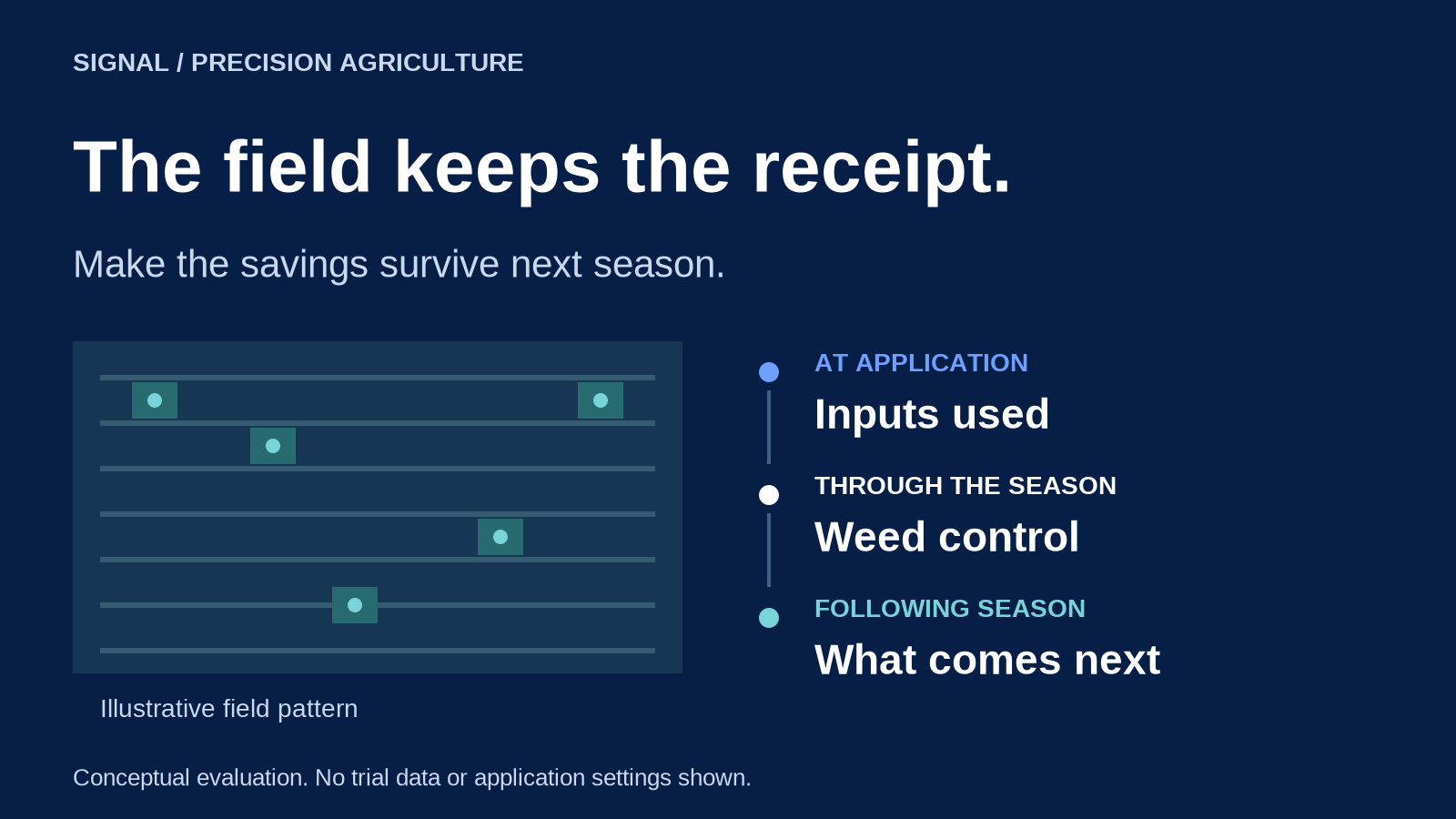
We would agree three checkpoints before a demonstration or limited deployment. The agronomist defines appropriate observations and timing; the buyer defines the cost record and purchasing decision.
| Checkpoint | What the buyer needs to learn |
|---|---|
| At application | What was applied, where, under which configuration, and at what complete operating cost? |
| Through the season | Did the agreed program control the weeds, and what additional work was needed? |
| Following season | What do field observations show about subsequent weed pressure and management needs? |
This is our proposed evaluation framework. It does not imply that a supplier automatically records every item or that field observation alone measures the entire soil seedbank.
Retain the starting condition, field history, crop, treatment plan and machine configuration with the results. If the program or settings change, keep the change visible. Have the responsible specialists design a meaningful comparison; weather, crop rotation and a different field can otherwise obscure the reason for a result.
A short demonstration can establish handling, workflow and how the records are produced. It cannot establish a multiseason outcome. Where the buying timetable is shorter, combine relevant published evidence with a limited operating commitment and an explicit follow-up plan. Decide in advance what evidence would justify expansion and what would require changing the program.
Sell a result the customer can keep
The commercial opportunity is substantial in principle: target a repeated physical task more precisely, retain useful output and reduce unnecessary consumption. A supplier that helps customers validate that combination has a stronger proposition than one selling an isolated reduction figure.
For investors assessing industrial automation, our view is that recurring customer value deserves as much attention as technical novelty. Can the company install and support the system, explain its operating limits, and show why a customer would renew or expand after ordinary use? The answer needs the customer's costs and results, not only the supplier's application statistics.
For VoltSmiths, this is a useful discipline as we pursue autonomy in the work that vehicles and their installed equipment perform. Define the customer's result, account for the full duty, and keep looking after the first successful pass. The strongest savings are the ones the customer can still recognize next season.
Sources and further reading
- Avent and colleagues — Weed population impacts using targeted herbicide applications with a precision sprayer in soybean over a three-year period; Weed Technology 40, e9 (2026)
- University of Arkansas System Division of Agriculture — March 2025 account of the trial and equipment configurations
- John Deere US — Current licensing options and definition of application savings