
Measure the queue before adding trucks
For quarries and construction fleets, loading, dispatch and receiving capacity decide whether another vehicle adds useful output.
BLUF
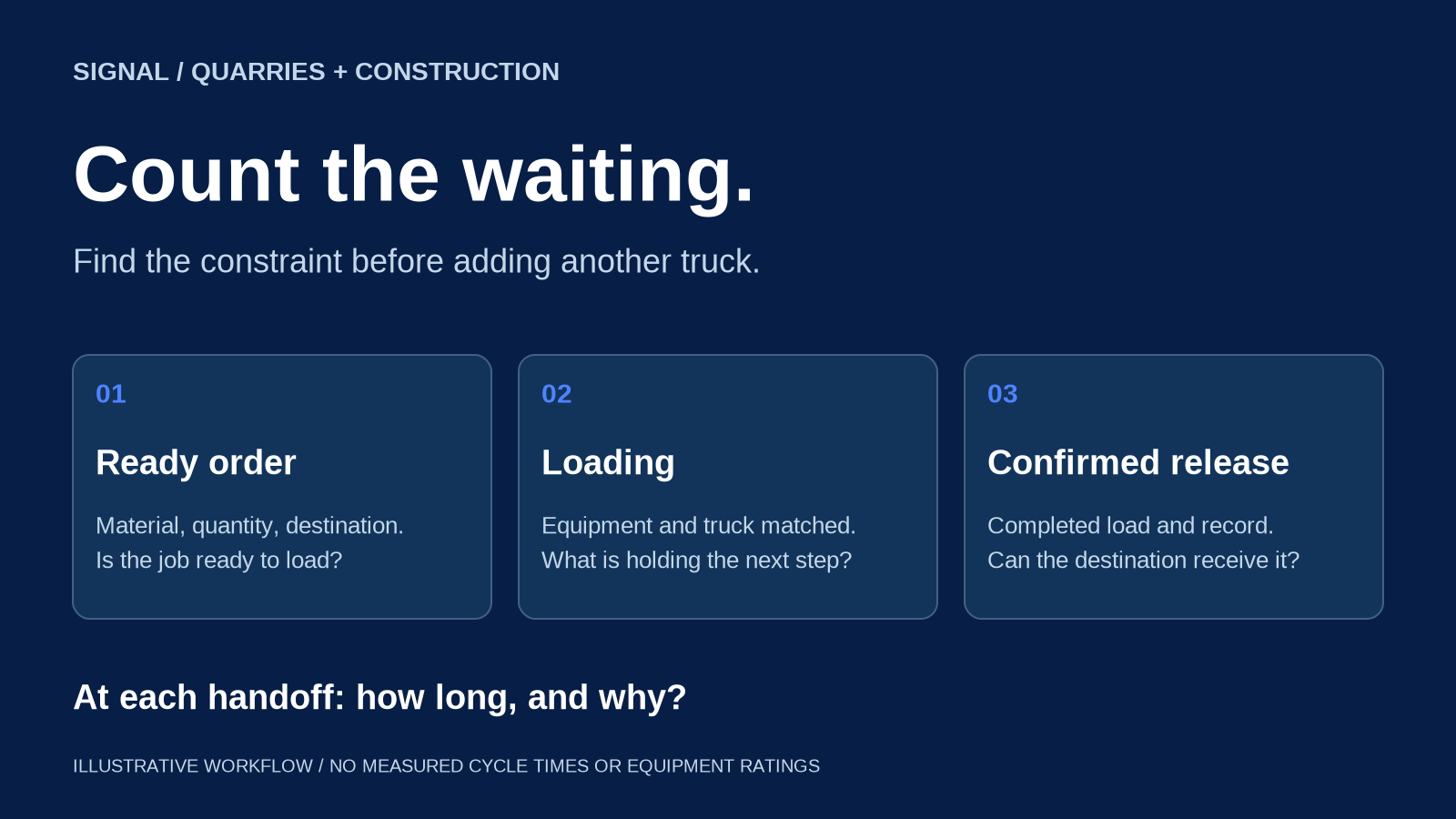
Before adding trucks to a hauling operation, find out where the existing ones wait and why. A loading queue, a missing material order and an unavailable receiving point are different constraints. Vehicle capacity helps when the operation can use it. Better coordination may help when the capacity is already there but poorly matched to the work.
For quarry managers and construction fleet leaders, the useful technology story is the connection between dispatch, loading and a confirmed delivery. Caterpillar and Volvo describe tools that make those connections visible. Their product descriptions establish available approaches, not a guaranteed improvement at your site. The buying question is whether a change increases correctly completed loads under the conditions you actually operate.
Give waiting a location and a reason
A line of trucks is an observation. It is not yet a diagnosis.
Consider a hypothetical aggregates yard where trucks arrive in a morning cluster. Some wait for a loader. Others have an unresolved order, need a different material, or cannot depart because the receiving job is not ready. Those trucks may look similar on a map. Sending another vehicle into the yard would not resolve every one of those problems.
For a baseline, we would separate arrival, ready-for-loading, loading start, loading completion and release. Record the required material, destination and reason for any hold. On a repeating internal haul, add travel, unloading and the empty return. Agree the event definitions before comparing machines or shifts.
A truck has not necessarily started queuing for the loader just because it crossed the gate. It may still need an order checked. Likewise, a completed bucket sequence does not prove the load is ready for release. A useful record keeps those distinctions instead of putting every unexplained minute in one large idle-time drawer.
The queue is a very expensive place to store horsepower.
Send the order ahead of the steel
Volvo's published Connected Load Out service description illustrates a specific information handoff. Its Entry version connects the site office and loader operators. Its Flow version adds incoming truck drivers, who can place material orders in the app; the loader operator can prioritize orders and call a truck forward. Completed orders produce load tickets shared with the office and, in Flow, the truck. The document specifies compatible Co-Pilot, internet and weighing requirements. Confirm the current package, equipment and local availability with the supplier. Volvo Connected Load Out service description, pages 1–2.
The opportunity is earlier knowledge of the job. An order can tell the site what is coming before the vehicle occupies a loading position. A shared completion record can reduce the uncertainty about what left. Neither requires pretending that the truck, loader or receiving customer has unlimited capacity.
For a buyer, we would trace one representative order through the actual workflow. Who creates it? Who corrects a changed quantity or destination? Which person authorizes the next step? If the connection fails, how does the crew follow the site's approved fallback and reconcile the record later? A digital ticket is useful when people can rely on its meaning.
Dispatch can change without changing who drives
Caterpillar describes MineStar Fleet as providing visibility into cycle time, payload and material blends, and allowing equipment to be rescheduled or reassigned as operating requirements change. It also describes automatic haul-truck assignment and tracking where material is headed. These are manufacturer-stated capabilities in a mining fleet-management context. They do not establish autonomous driving or suitability for every construction fleet. Cat MineStar Fleet.
That distinction creates a useful middle ground for operators considering automation. The assignment process can become more informed while driving remains a separate responsibility. A fleet can investigate dispatch, order handling or reporting without assuming that it has purchased a driverless operation.
Our practical test would be whether a changed assignment resolves a real constraint. If loading capacity is available elsewhere and the alternative accepts the required material and vehicle, reassignment may help. If the receiving operation is already full, making every truck arrive sooner may simply move the queue.
Those are hypotheses for site managers to evaluate within approved traffic and operating procedures. A productivity trial is not a reason to relax route restrictions, increase speed or exceed rated loads. The target is better coordination of supported work.
Check what the dashboard cannot see
Volvo's Performance Indicator page describes production, fuel-efficiency and cycle information. It identifies Connected Map as a prerequisite and explains automatic capture with supported Co-Pilot and On-Board Weighing equipment. For non-Volvo transporting machines using a generic Co-Pilot, production information can be entered manually; the page explicitly excludes their fuel data and machine hours. Volvo Performance Indicator.
That boundary matters in a mixed fleet. A screen can show several brands without providing equally complete measurements for each. Missing fuel data is not zero fuel consumption. Manually entered production deserves a different completeness check from an automatically captured event.
Before comparing results, ask for a field-level inventory: what is measured, what is entered, what is inferred and what is unavailable? Check timestamps, material identifiers, units and missing records against a small sample of actual loads. Keep incomplete records visible in the assessment. A tidy average should not quietly discard the difficult part of the operation.
Decide which constraint deserves the money
We would use a short observation period covering representative assignments, followed by one controlled operational change. Retain the baseline and note changes in haul distance, material, weather, loading equipment, staffing and receiving capacity. Otherwise, a different job can masquerade as a better system.
| Observed pattern | Question to resolve before adding capacity |
|---|---|
| Trucks wait while the assigned loader works continuously | Is loading the constraint, and can it be addressed within the site plan? |
| Loader waits while eligible trucks are unavailable | Is there a haul-capacity gap, a dispatch problem or an interruption elsewhere? |
| Trucks wait on orders or release information | Can the information reach the responsible person earlier? |
| Loads move promptly but wait at the destination | Can the receiving operation accept the proposed increase? |
| Mixed-fleet records disagree or contain gaps | Is the comparison complete enough to support a decision? |
Judge the change by correctly delivered material over an agreed operating period, together with the resources consumed and exceptions encountered. Confirm the material reached the intended destination; moving a wrong load quickly is still rework waiting to happen. Record queue duration and its spread, rather than relying only on a fleet-wide average.
If another truck is justified, the baseline helps define its useful duty. If coordination is the constraint, the first purchase may instead be a service or process improvement. Either case needs a realistic account of setup, connectivity, training and support, and evidence that the benefit survives ordinary shifts.
For VoltSmiths, this is part of understanding the customer before specifying the vehicle. The truck belongs in a working operation with loaders, crews and destinations. Better vehicle capability becomes commercially useful when that operation is ready to put it to work.