
One fleet. Fewer morning reports.
Mixed-fleet data should make the working day easier. Check coverage, meaning and freshness before relying on a common operating view.
BLUF
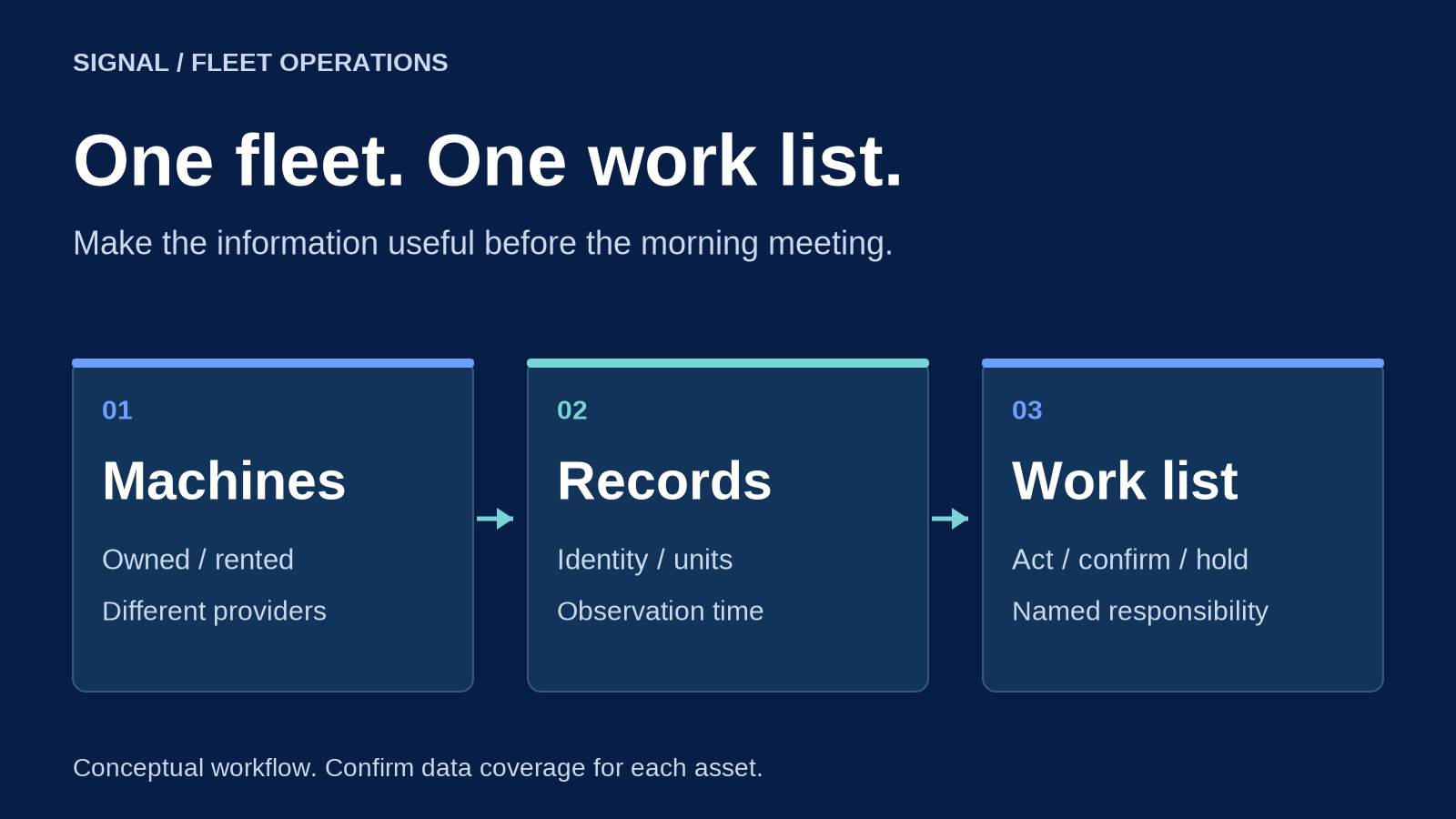
A mixed fleet should be easier to manage as it grows. Connecting equipment data can give construction and public-works teams a common starting point for the day: which assets need attention, which records need checking, and who takes the next action. The purchasing question is whether the connection produces a dependable work list with less manual reconciliation.
That is a useful opportunity for vehicle and equipment suppliers. A new machine should fit the customer's information flow as well as the jobsite. Another login is easy to deliver. A clearer morning takes more thought.
Start with the report people already assemble
Imagine a hypothetical contractor running machines from several manufacturers, a few service vehicles and rented equipment. Before the morning meeting, someone gathers meter readings, checks locations, consults the maintenance record and asks a supervisor about an asset whose status is unclear. The resulting report may be useful. Building it repeatedly is also work.
We would start an integration project by observing that routine. Identify the decisions it supports and the sources people actually trust. A maintenance planner may need an updated hour reading. A dispatcher needs confirmation that a machine is available for its assignment. Those are related questions, but a meter reading cannot answer both.
Caterpillar describes VisionLink integrations that bring data from supported manufacturers, telematics providers and business systems into a common view. Its setup guidance includes obtaining provider credentials, configuring the integration and arranging the relevant subscriptions with a dealer or VisionLink specialist. This is a supported integration offering, not a promise that every machine and field will appear automatically. Cat's integration guidance.
The business case begins where repeated collection and copying can become a dependable connection. It becomes stronger when the same information reaches the person who can act on it. An impressive fleet map can still leave the planner doing the morning spreadsheet by hand.
A common interface covers part of the journey
An application programming interface, or API, is a defined way for software systems to exchange information. In this setting, it can let a fleet application retrieve data held by an equipment-data provider.
The public abstract for ISO/TS 15143-3:2020 describes a communication scheme between a telematics provider's server and customer applications. Its scope concerns earth-moving and mobile road-construction machinery. It explicitly excludes onboard data collection and the wireless transfer from a machine to the provider's server. We use that published scope, rather than claiming to have reviewed the full paid specification. ISO's public scope description.
The practical implication is that a compatible exchange format addresses one part of the path. The buyer still needs to establish which machines produce the required information, how it reaches the provider and what the receiving application does with it. The specification's scope is not evidence that an arbitrary service truck, rented machine or business system is compatible.
For a quote, request a coverage list for the actual assets. Identify the installed equipment, available fields, receiving application and any required services. Keep a manual record visibly manual where a supported connection is unavailable. A useful common view can include exceptions; it should not disguise them.
Put the age of the answer beside the answer
Wirtgen Group's Operations Center Construction FAQ says available data depends on installed machine hardware. It also says update intervals depend on the machine and type of data, and that receiving data in real time requires a mobile-network connection. These are the supplier's stated conditions for that environment, not a universal reporting interval for all fleets. Wirtgen Group's data and connectivity FAQ.
That makes freshness a purchasing requirement. A location recorded earlier may be adequate for a historical report and inadequate for deciding where to send a technician now. A recently refreshed screen does not, by itself, tell the reader when the underlying observation was made.
We would ask the supplier to show the observation time and, where available, when the receiving system obtained it. Have the fleet's responsible team define acceptable age for each decision. Do not impose one arbitrary interval on maintenance planning, historical reporting and dispatch alike.
In a demonstration, ask what appears when a machine has not reported. The application should make the uncertainty understandable. An old value carried forward without its age can look reassuring for exactly the wrong reason. A quiet data connection is not proof that the equipment is idle, healthy or ready.
Build a short, comparable fleet record
Our proposed record would keep a few essentials together before combining brands or calculating totals:
| Record element | Question it must answer |
|---|---|
| Asset identity | Is this the same physical machine in the fleet, provider and maintenance records? |
| Value and units | What was reported, in which units, and over what period? |
| Observation time | How old is the information supporting this decision? |
| Origin and gaps | Is it measured, manually entered or derived, and what is missing? |
| Next action | Who confirms, acts or resolves the exception? |
This is our evaluation framework, not a list of fields guaranteed by the cited products or specification.
Trace a small sample all the way through. Compare the provider's record with the receiving application and the fleet's own asset list. Check whether identifiers remain stable when a display name changes. Establish how the team distinguishes a cumulative meter reading from activity during a selected period before using either in a comparison.
Then connect the record to its operating context. An hour reading can inform a service plan alongside the applicable maintenance requirements and service history. It cannot show that a technician completed an outstanding repair. A location can help find a machine; it does not establish that its attachment, operator or required inspection is available.
The common report should make those unresolved questions easier to find. Its purpose is to shorten the path to a supported decision.
Prove the reduction in office work
Run the proposed reporting flow alongside the existing process for representative working days. Include a rental change, an asset with incomplete coverage and a delayed update. Use ordinary records or a supplier's test environment; there is no need to interrupt equipment communications to create a demonstration.
Measure time spent assembling the report, corrections needed, missing records and actions that remained unresolved. Check the result with the people using it. If someone still has to rebuild the same spreadsheet after the integration runs, the saved effort has not yet been demonstrated.
Include subscriptions, setup, data mapping, support and ongoing administration in the cost comparison. Ask what happens when equipment is added, rented assets leave or a service arrangement changes. Establish the supported export and retention arrangements before relying on the report as the fleet's history. These are commercial questions to resolve with the suppliers, not assurances supplied by an API label.
For VoltSmiths, this is a practical route to customer value: understand how an operator manages the machines already in service before adding another. The opportunity is equipment that joins a dependable operating picture, with clear information and support for the next useful action. The customer should gain capacity without also acquiring a part-time job in data reconciliation.