
Put uptime in the purchase order
A work vehicle's support plan belongs beside its specification. Measure the path back to work—and make the economics earn their keep.
BLUF
Buy a credible path back to work along with the vehicle. Ford's mobile-service offering and Caterpillar's repair commitments show two ways suppliers make support part of the product. For a fleet buyer, the useful question is specific: when this vehicle cannot do its assigned job, who restores it, how long does that take, and what does the interruption actually cost?
That question belongs in the purchasing decision for service trucks, utility fleets and construction equipment. It also belongs in an investor's assessment of an ambitious vehicle company. A feature can win the demonstration. Repeatable support has to survive the customer.
The warranty answers only part of the question
Consider a hypothetical field-service truck with a failed component. The repair may be covered, yet the crew still needs transport, tools and a way to reach its next assignment. A replacement pickup helps only if it can carry the required load and equipment. A reimbursement later does not dispatch today's crew.
This is an operating example, not a report about a manufacturer or a promise that every failure stops work. Some jobs can move to another vehicle. Some can wait. Some interruptions consume a scarce backup or force an additional trip. The buyer needs to know which situation applies.
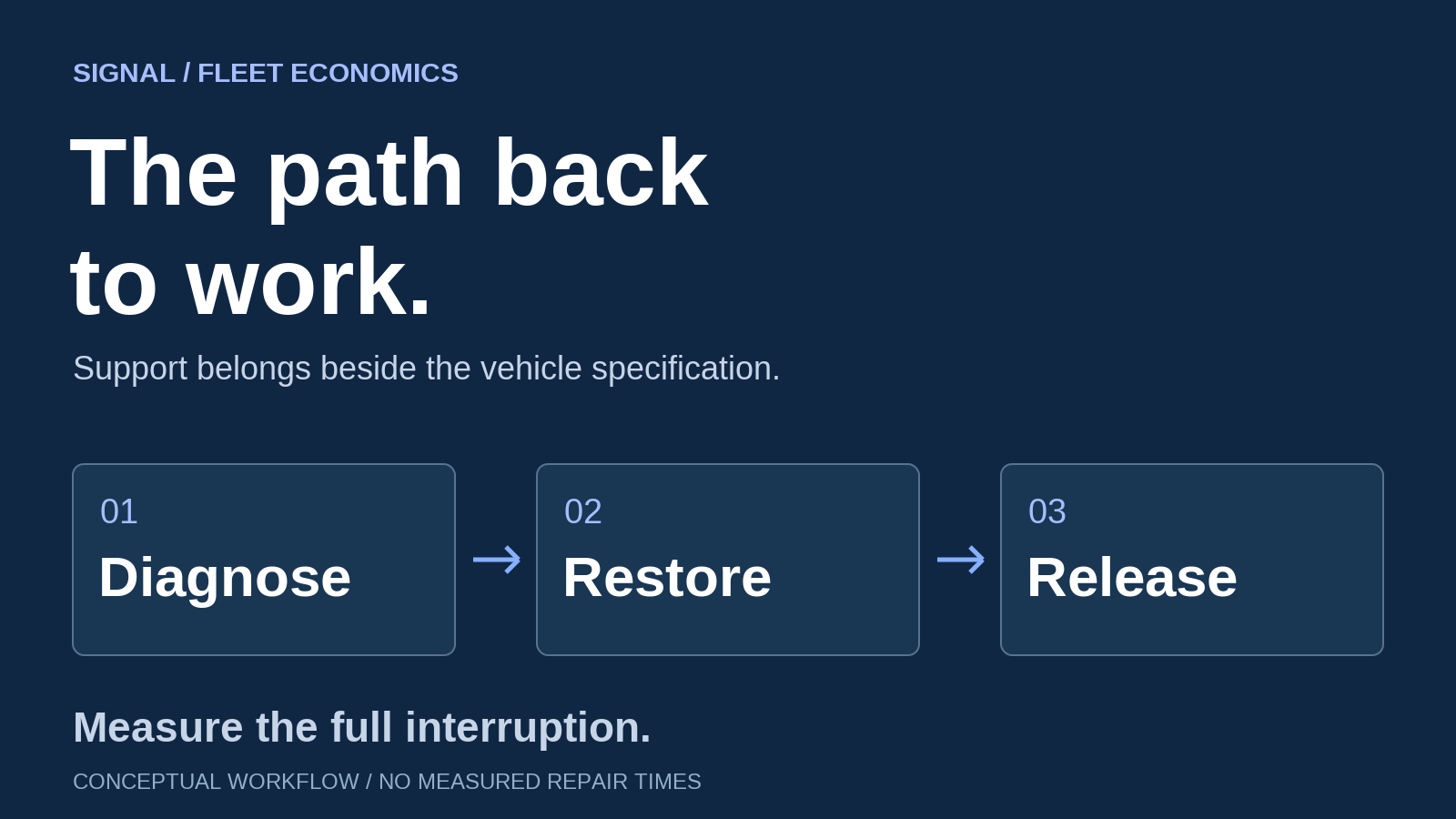
We would record the whole interruption: when the fault was reported, when someone took responsibility, when the problem was diagnosed, when parts became available, when the repair finished and when the vehicle was cleared for its assigned duty. Stages can overlap; the overall elapsed time matters as well as the time spent at each stage.
“Covered under warranty” is good news. The crew would also like a truck.
Bring the service closer to the work
Ford lists mobile-service tasks including oil and filter changes, brake services, batteries, diagnostic scanning and software updates. Its guidance says services vary by dealer, participation and availability are limited, and distance restrictions may apply. The complimentary mobile visit does not include parts or repair charges. These are Ford's descriptions of its offering, not evidence that every commercial configuration or fault can be serviced on site. Ford Mobile Service.
The purchasing implication is to test the route to service against the actual fleet. Can a technician reach the yard? Can the visit fit around dispatch? Which repairs require a workshop, transport or specialist equipment? What happens when the fault involves an added body, hydraulic circuit, sensor or control system?
For an integrated work vehicle, ask for one clear route to diagnosis even where several suppliers carry different responsibilities. The customer should not have to conduct a conference call between a chassis, an upfit and a software license.
A supplier does not need to promise every repair at the roadside. It needs to explain the boundary and the next step. Useful support can mean a fast diagnosis, the correct part identified before collection, or a planned service window that avoids moving the crew twice. Those are hypotheses to verify with local service teams and operating records.
Read the clock behind the commitment
Caterpillar's December 2025 announcement describes a two-day commitment for common repairs under qualifying Customer Value Agreements that include dealer labor. It says rollout begins in 2026 and continues into 2027, subject to regional availability. Its current US campaign describes two business days for covered common repairs and Cat Credits if the commitment is missed; dealer participation and terms require confirmation. These are conditional program descriptions, not a universal repair guarantee. Cat announcement, US program details.
That is a useful example of making service measurable. When comparing an offer, ask what starts its clock: the first fault report, arrival at a workshop, diagnosis or approval to proceed. Ask what stops it, whether weekends count, which repairs qualify and what happens outside the covered area.
Keep the remedy separate from the operating outcome. A service credit has value, but its face value is not necessarily cash returned or the value of work recovered. Check what the customer can actually use it for. The best comparison is the service commitment, its exclusions and the fleet's fallback plan together.
Give downtime an honest number
NTEA's Vehicle Life Cycle Cost Tool supports vehicle and fleet comparisons, what-if scenarios, and inputs concerning depreciation, fuel and tax. Access is restricted to members. Its public description is a reminder to compare ownership over time; the illustration below is our own, not a result from that tool. NTEA's tool overview.
Suppose, purely for illustration, an enhanced support arrangement costs an additional $1,800 per vehicle per year. Suppose the buyer estimates $600 of avoidable disruption cost per lost duty day, after allowing for reassignment and backup vehicles. The simple break-even is three avoided days a year: $1,800 ÷ $600.
| Assumed avoidable cost per duty day | Avoided days needed to cover $1,800 a year |
|---|---|
| $300 | 6 |
| $600 | 3 |
| $900 | 2 |
These are invented sensitivity inputs, not vendor prices, industry averages or promised savings. Assume the service costs and avoided costs occur in the same year; this narrow comparison omits financing, taxes and changes elsewhere in ownership cost.
Do not stack a full day's lost revenue, crew wages and replacement-vehicle expense if they describe overlapping losses. Count incremental costs and genuinely lost contribution after avoided costs. If the crew completes the work with a spare truck, the effect may be additional expense or lost reserve capacity, rather than the entire job's revenue.
The calculation produces a testable question: can this support arrangement credibly avoid enough disruption under our conditions? It does not prove the arrangement will do so. If a fleet rarely loses the required number of days, the case needs another measurable benefit.
Put five answers beside the vehicle quote
Before a trial or purchase, we would request a short service plan covering:
- Ownership: one intake route and a named process for assigning chassis, upfit and software faults.
- Access: service geography, hours, transport arrangements and the jobs technicians can perform at the operating site.
- Recovery: parts availability, escalation, repair-clock definitions and a practical fallback for essential duties.
- Return to duty: required checks, configuration records and the person responsible for clearing the repaired vehicle.
- Economics: recurring fees, excluded charges, remedies and a transparent estimate of disruption avoided.
Then examine real service records or exercise a representative service scenario before scaling. A useful trial can test the contact route, diagnostic information, parts identification and return-to-duty documentation without deliberately causing a hazardous failure. Record exceptions as carefully as successful recoveries.
For investors, this is where a promising product becomes a delivery obligation. Our assessment is that a credible business case must account for technician time, parts, diagnostics and support commitments alongside vehicle margin. A company that prices the sale but underestimates its obligations can win customers on terms it cannot sustain.
VoltSmiths' development approach should earn confidence here: define the useful duty, design for service access and make responsibility clear. As capability grows, the path back to work must grow with it. The customer is buying useful capacity. We should be able to explain how we intend to keep it available.