
The attachment is part of the purchase
A compact loader earns its versatility through the complete match: the work tool, hydraulics, controls and the job it can actually finish.
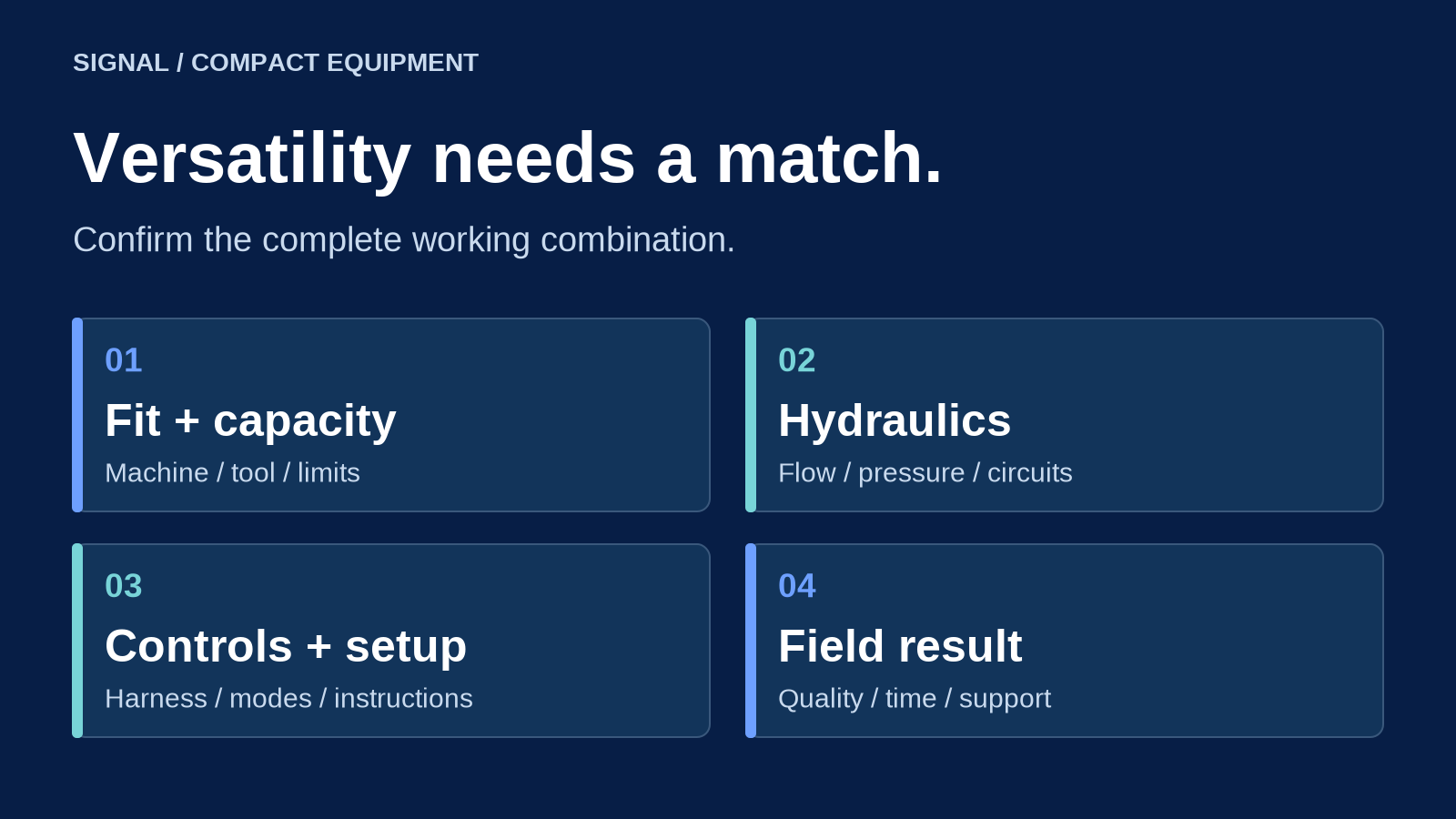
BLUF
Buy the loader and its intended attachments as a working combination. For contractors, public-works crews and rental fleets, the opportunity is more useful jobs from a familiar machine. The purchasing decision needs to cover the complete match: mounting and capacity, hydraulics, controls, and evidence that the combination performs the required work.
Write the job list before the option list
A compact loader can be a compelling piece of shared capacity. One crew may need to move material, another to sweep a paved area, and another to prepare a surface. That versatility becomes valuable when the right attachment can actually go to work on the machine available that day.
Consider a hypothetical contractor buying a loader for routine material handling while planning occasional pavement repairs. The bucket demonstration answers only part of the purchase. The proposed planer has its own requirements, and the company may expect a second loader to cover the work during a service interruption. Those two combinations deserve separate confirmation.
We would give the supplier a short duty list: the material, required result, working space, expected frequency and attachments already owned. Identify the recurring assignments that justify the machine, then distinguish a planned expansion from a task somebody might pursue someday.
An attachment catalogue is a menu. The business still needs an order.
A matching coupler does not complete the specification
Bobcat's attachment guidance says its attachments are not universally compatible across machines and applications. It identifies equipment family, mounting interface, hydraulic flow and pressure, machine capacity, and attachment weight and width as relevant. Its guidance also calls out required control kits or harnesses and confirmation of the approved match. Bobcat attachment compatibility guidance.
The practical consequence is to identify the exact machine configuration and attachment variant in the quote. A broad description such as high-flow loader with planer leaves too much unresolved. Ask the supplier to document the supported combination, required options and operating instructions, including the limits that apply to the intended task.
For existing equipment, record the asset and attachment identities rather than relying on appearance. Two machines in the same yard may have different installed options. A rental replacement should be checked against the same requirements before it is accepted as equivalent capacity.
Our proposed purchase record would be deliberately small:
| Part of the match | What the buyer should have in writing |
|---|---|
| Machine and attachment | Exact models, relevant configuration and confirmed fitment |
| Capacity and dimensions | Applicable rated limits, attachment mass and working envelope |
| Hydraulic circuit | Required flow, pressure, couplers and any additional connections |
| Controls and setup | Required harnesses, controller, display functions and instructions |
| Intended job | Representative material, required result and agreed demonstration |
This is a buying checklist, not an engineering approval or a universal compatibility chart. The applicable manufacturers' instructions govern the actual configuration and operation.
Match hydraulic demand, including the less visible connections
CASE's 2016 hydraulic-system explainer distinguishes standard, high and enhanced high-flow packages. It explains that attachments have different requirements and warns against assuming an attachment should always receive all the flow and pressure the carrier can supply. We use that dated guidance for the matching principle, not its historical ranges as specifications for today's machines. CASE, Go With the Flow.
For a purchase, ask for the required operating range and the supported machine setting. A larger capability label alone does not answer whether the attachment will operate properly. The supplier should account for the specific circuit and the task, rather than treating maximum output as the universal objective.
A concrete example appears on CASE's Africa and Middle East chipper page: it lists a case-drain line as a requirement for both the standard-flow and high-flow models described. That is an additional connection requirement beyond the flow category. The regional listing does not establish current US availability or compatibility with an arbitrary loader. CASE chipper requirements.
The buyer's question is straightforward: what must be present on the actual carrier before this tool can work? Have the supplier resolve missing circuits, couplers or kits as part of the specification. This is not a suggestion to improvise hydraulic plumbing in the yard.
Controls can make an older machine useful in a new role
Caterpillar's March 2023 announcement provides a useful example of integration extending an attachment's reach. It described an external control kit for GB120 and GB124 smart grader blades, expanding use to D and D2 series skid-steer and compact track loaders. The kit included an additional joystick, wiring harnesses, mounting components and hardware. Caterpillar also described automatic detection of a D3 machine versus one equipped with the external controller. Cat's 2023 smart-blade expansion.
The example shows why controls belong in the purchase discussion. A compatible installation may need more than the work tool itself. It also shows that an older carrier need not automatically be excluded when the manufacturer provides a supported integration route. Current machine-specific eligibility, kit availability and specifications still require dealer confirmation.
For the operator, we would ask for a demonstration of the supported control arrangement: how the attachment is identified, which controls perform which functions, and how the operator confirms the correct mode. Training should cover the actual combination being delivered. Familiarity with a loader does not establish familiarity with every attachment-control arrangement.
This is task integration with an operator. Nothing in this example establishes driverless operation or compatibility with a proposed VoltSmiths vehicle.
Put the second job in the demonstration
The useful acceptance test follows the work that justified the options. If pavement repair is part of the business case, arrange a supplier-led demonstration of the approved machine and tool on representative material, under the applicable operating instructions and site controls.
Agree what a satisfactory result looks like before the demonstration. Record completed work, quality, time spent changing and setting up attachments, interruptions and the resources consumed. For a cutting task, the required finish and amount of rework belong beside the production rate. Keep conditions comparable; a convenient demonstration surface may not represent the customer's ordinary assignment.
Have the supplier explain the required maintenance and consumables for that combination. Establish who handles an issue that could originate in the carrier, the tool or the interface between them. Where a backup machine is part of the operating plan, confirm its supported configuration separately.
Then compare complete alternatives. Owning the attachment, renting a matched combination, or hiring a specialist may each fit a different frequency and scale of work. Include the tool, necessary machine options, installation, training, transport, maintenance and storage. Credit only work the business can reasonably expect to perform. A future job that never arrives cannot pay for today's hydraulic package.
The opportunity for equipment suppliers and integrators is substantial: turn a collection of supported components into a useful, repeatable working configuration. Its commercial value has to survive the ordinary changeover, the substitute machine and the person who actually runs it.
For VoltSmiths, that is a practical lesson as we consider work vehicles and future equipment platforms. The useful product includes what the machine carries, powers and controls. Define that combination around a real assignment, and the customer gets a clearer reason to buy it.