
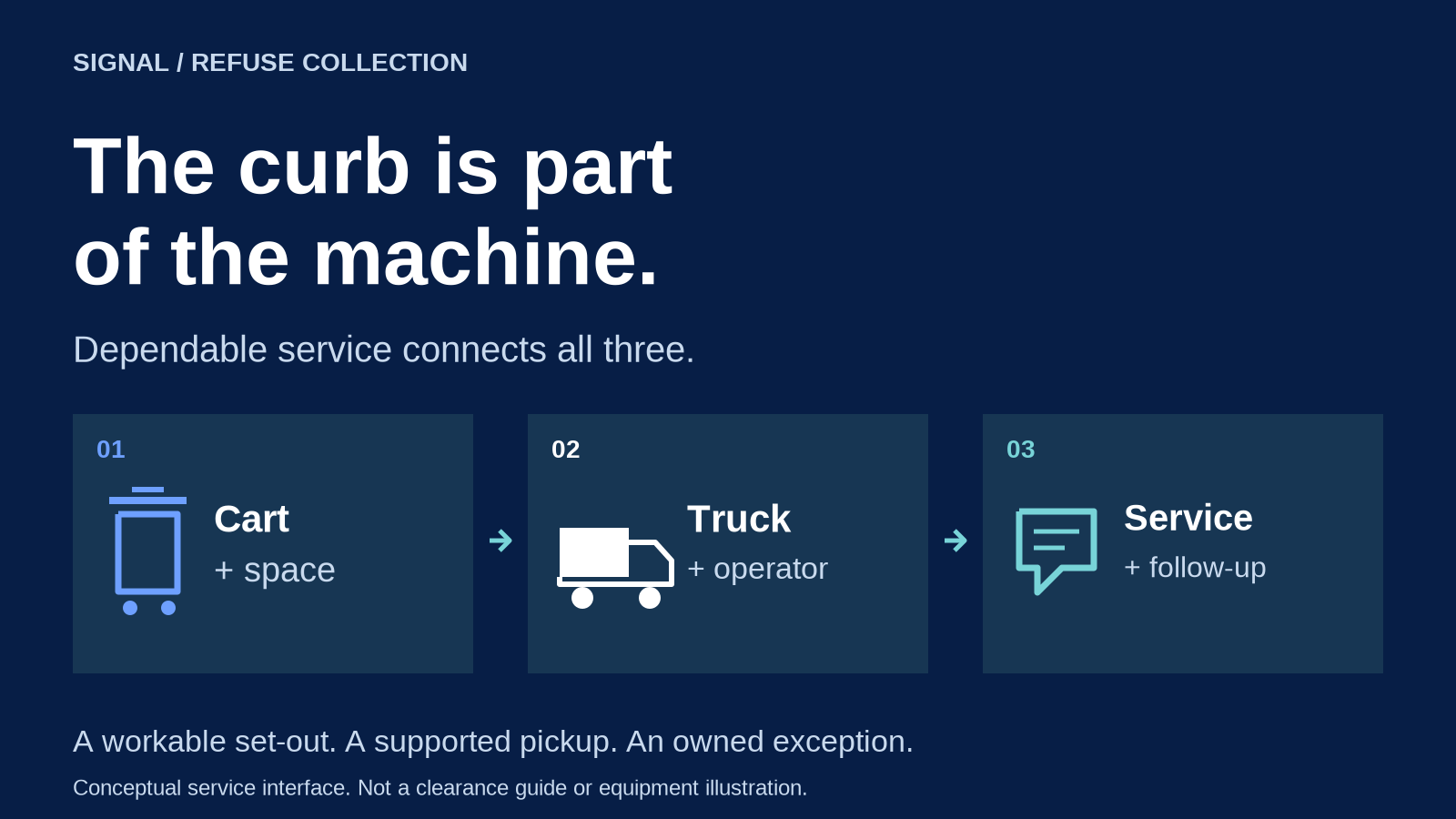
The curb is part of the machine.
Automated collection arms can make each stop more consistent. Cart placement, operator responsibilities and service exceptions decide how much of that value reaches the route.
BLUF
A better collection stop starts before the truck arrives. Vision-guided lifting arms offer municipalities and private haulers a concrete way to automate repeated work. Their value depends on a usable interface with the street: the right cart, accessible placement, a trained operator and a practical response when collection cannot proceed.
For a fleet buyer, that means evaluating the truck and the collection arrangement together. The exciting opportunity is more dependable service across many ordinary stops. It begins with understanding why some stops are ordinary and others consume half the morning.
The curb is an interface
Austin Resource Recovery asks residents to place carts five feet apart, with handles toward the house, and keep sidewalks and bike lanes clear. Its guidance explains that closely spaced carts or nearby objects can require drivers to leave the truck and reposition them. The city also provides different placement scenarios where bike lanes or limited space complicate collection, and offers help resolving unusual locations. These are Austin's instructions, not universal clearances for every truck or community. Austin's set-out guidance.
That is a revealing piece of industrial engineering disguised as a household chore. Cart placement connects the resident's action to the vehicle's working equipment. Better machinery cannot make that handoff irrelevant.
Consider a hypothetical neighborhood where most carts are accessible, but several collection points repeatedly conflict with parked vehicles or the available curb space. A faster arm may improve the straightforward stops. It does not, by itself, decide where the difficult carts should go or arrange an appropriate service alternative.
The useful response is to identify those locations before changing the collection equipment. Bring route supervisors, operators and the people responsible for resident communication into the purchase discussion. They know which difficulties recur and which can be resolved through a clearer set-out arrangement.
The curb did not read the product brochure.
The arm can do more while the driver remains involved
McNeilus describes CartSeeker as a camera- and sensor-based collection system for its Zero Radius side loader. Its published sequence uses visual cues to guide the driver's truck positioning. After alignment, the operator uses a presence switch and activation button; the arm then extends, grips, empties and replaces the cart before returning home. The page also describes position sensing for the arm. These are manufacturer-described functions of that equipment, not independently measured route results. McNeilus CartSeeker.
This is a useful example of automation reaching the work itself. Recognition, positioning and manipulation become parts of one supported collection sequence. The documented driver role remains explicit; automating the lifting task does not establish driverless travel between stops.
Heil's current Sentien description provides another example: it links full arm-position sensing with functions such as Auto-Lift and Pick-and-Place. Heil describes autonomous-ready features, which buyers should distinguish from the exact functions included in a delivered configuration. Its page establishes a supplier's design approach, not equivalence with CartSeeker or a shared definition of road-driving autonomy. Heil Sentien.
For buyers, the productive question is what the operator does at each stage on the actual truck being quoted. Which positioning decisions remain manual? What confirms a supported pickup? Which movements are automated? Ask the supplier to show those boundaries with the carts and collection conditions the fleet expects to encounter.
There is real value in making a demanding repeated task easier to perform consistently. That value does not require turning every feature name into a claim about the whole vehicle.
Count the stops that actually improve
Small changes can matter when work repeats. Suppose, purely for illustration, a route has 1,000 collection stops and a change saves three seconds at every stop, with everything else unchanged. The arithmetic is 3,000 seconds, or 50 minutes.
Those are invented inputs, not a typical route or a claim about either product. If only half the stops benefit, the same calculation gives 25 minutes. Neither number is a complete route saving until added positioning, interruptions and follow-up work have been counted.
This is why a quick lift-cycle demonstration is only a starting point. A fleet needs to know how much of its actual work fits that demonstration. Count successful collections, stops requiring repositioning, manual collection, unresolved access and return visits. Keep their causes visible. An inaccessible cart, an equipment fault and a cart that was never set out call for different remedies.
Compare the complete service period with similar work: comparable stop counts, collection quantities, disposal travel and operating conditions. Have the team define what completed service means, including the cart's return and any necessary follow-up. A passed address is not automatically a served customer.
The commercial question then becomes concrete. Does the improvement create usable route capacity, more reliable completion or a manageable reduction in overtime? Time recovered at scattered stops is valuable, but it should not automatically be booked as a vehicle or staffing reduction. The operating schedule has to show what can actually change.
Give the awkward stops an owner
McNeilus's FAQ says excess water or dust on the LiDAR sensor can produce an error for the operator to address. It also describes manual collection options. Those statements are reasons to include sensing conditions and the operator's supported response in training; they are not a procedure for improvising around a fault. McNeilus operating-boundary discussion.
A useful evaluation would include a supplier-led walkthrough of a supported pickup, a cart the system cannot service as presented, and an unavailable automated function. Use approved demonstrations or simulation for abnormal conditions. The fleet needs an understandable response, with equipment instructions governing actual operation.
Keep equipment exceptions separate from service exceptions. Maintenance owns a faulty component. A recurring placement problem may need a route supervisor and resident-service team. A location needing a different collection arrangement requires a service decision. Asking the operator to solve every category from the cab conceals work rather than removing it.
Include those responsibilities in deployment cost: cart changes where needed, location reviews, communication, operator training, maintenance and follow-up. A clearer interface can be an improvement in its own right, even before the next truck is delivered.
Build a service customers can recognize
Our view is that refuse collection offers an attractive model for industrial task automation: a recurring physical job, a recognizable object and a customer who can tell whether the service happened. The opportunity grows when the machine, its working environment and the service organization fit together.
For suppliers and investors, that suggests looking beyond the sophistication of the arm. Can the offering be introduced across real routes? Can the operator understand its limits? Can the business support the exceptions without losing the benefit of the successful stops?
For VoltSmiths, the lesson travels to other installed equipment and industrial duties. We intend to pursue autonomy in useful work, which means understanding the interface where the vehicle meets that work. Sometimes the next engineering requirement is on the truck. Sometimes it is five feet of space and a clear agreement about where the cart belongs.