
The depot needs a delivery date
Electric work vehicles need a ready place to recharge. Align the first fleet batch with site capacity, charging controls and a demonstrated departure plan.
BLUF
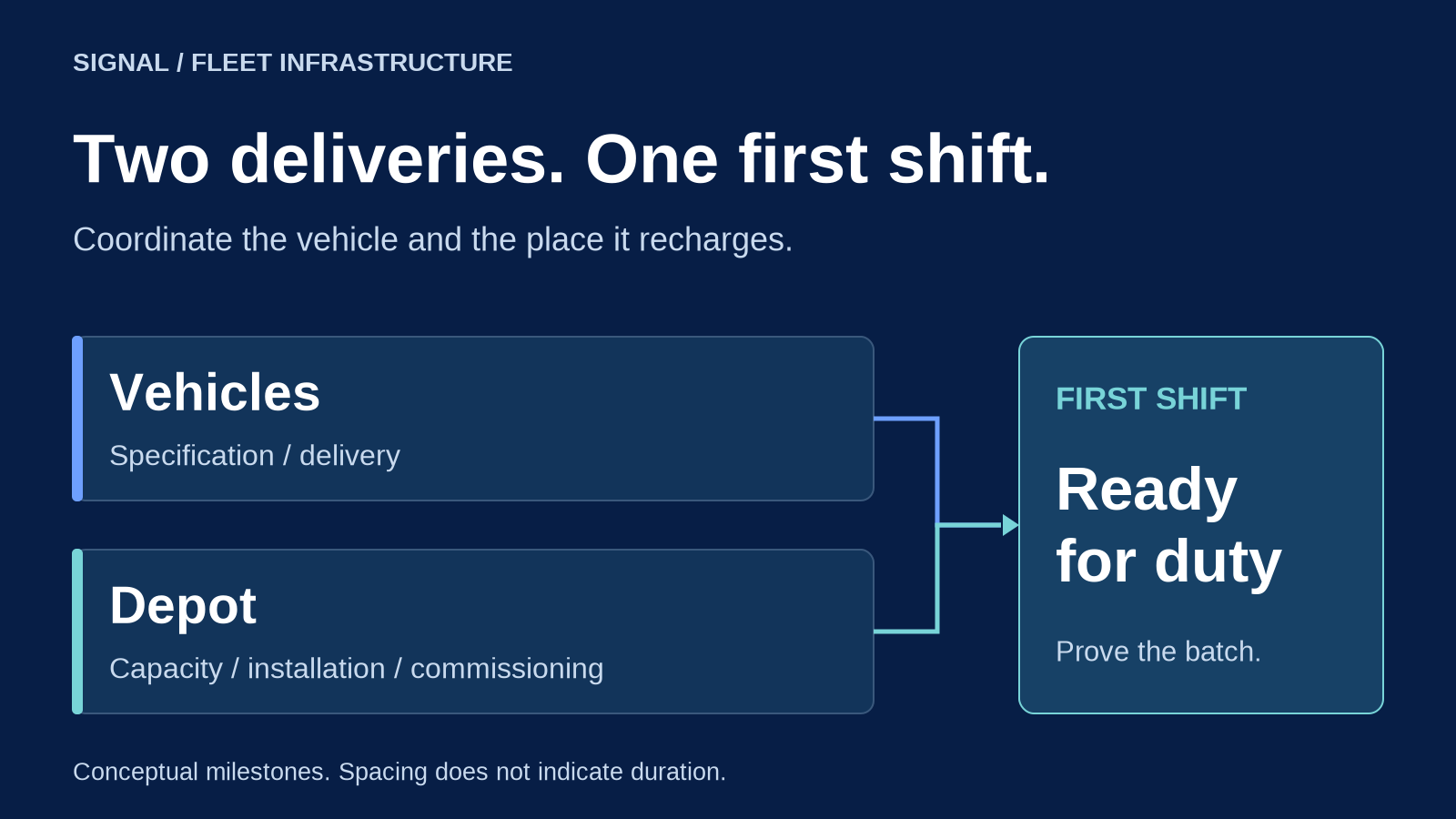
Give the depot a readiness date alongside the vehicle delivery date. For a fleet considering electric work vehicles, the useful purchase is a set of vehicles that can leave for their assigned jobs. That requires the charging site, available power and operating plan to come together before the first dispatch.
The opportunity is to introduce vehicles in batches the site can support, then expand from demonstrated operation. A truck delivery and a charger installation are milestones. Neither, alone, establishes that the fleet is ready for Monday.
Put the two delivery plans on one page
Imagine a hypothetical municipal service fleet preparing to introduce electric vehicles at an existing yard. Procurement knows when the vehicles are expected. Facilities has a charging proposal. Dispatch knows which crews leave early. Each team can be making progress while the combined start date remains unresolved.
DOE's Alternative Fuels Data Center recommends early utility involvement to assess charging requirements, electricity demand and potential upgrades. Its project-planning guidance explicitly calls for coordinating charging-equipment purchase and installation with vehicle delivery. It also recommends examining the fleet's energy requirements over time with the utility and equipment providers. AFDC fleet infrastructure guidance.
Our proposed project record would name one person responsible for the first usable fleet batch. Beside its vehicle count and assigned duties, record the site's approved capacity, outstanding work, dependencies and evidence required before dispatch. Keep forecast dates distinct from completed milestones.
An installed charger is an expensive place to discover that three departments meant different things by ready.
This is a coordination problem with an engineering core. The vehicle supplier can confirm the charging requirements of its product. The site team and utility must establish what the location can actually deliver. Procurement needs the combined answer before making operating commitments around the new fleet.
Bring a work schedule to the power conversation
A charger count tells the utility less than a credible account of the work. We would bring an operating profile for each planned batch: expected return times, next departures, replenishment needs, parking locations and the duties that cannot easily move to another vehicle.
Use representative assignments rather than the fleet's easiest day. A truck returning late from a field call and leaving early the next morning creates a different requirement from one parked through the weekend. An empty parking space is not evidence of an available charging connection.
DOE's Federal Energy Management Program identifies vehicle schedules and dwell periods, utility rates, building loads and transformer capacity and utilization as inputs to smart charge management. Its examples include allocating charging within a capacity limit and prioritizing vehicles with shorter dwell periods. This is planning guidance for federal fleets, not certification of a particular commercial product. FEMP implementation guidance.
For our hypothetical yard, that suggests comparing two workable dispatch plans before requesting the largest charging installation. Could routine vehicles use a longer connection window while an early-departure group receives priority? Would that arrangement still work when returns are late? The supplier should demonstrate the proposed behavior with the actual vehicle and site constraints.
Scheduling can distribute available power. It cannot make an infeasible energy-and-time requirement disappear. If the proposed batch cannot be replenished within the supported windows, the team needs a different batch size, schedule, charging arrangement or site plan. A dashboard should expose that conflict before the crew does.
Treat utility service as its own workstream
The Joint Office of Energy and Transportation describes utility connection, property-access arrangements and local permitting as parts of charging deployment. Its guidance emphasizes that permitting processes vary by jurisdiction and treats equipment energization as a distinct challenge. We draw the project-management lesson from that guidance, not a universal construction duration or a promise about any particular utility. Joint Office utility-collaboration guidance.
Ask the project team to separate what can proceed now from what depends on a service review, equipment delivery, construction or an inspection. Have the responsible specialists confirm the applicable requirements and dates for this site. A preliminary discussion is useful progress; it is not an energized connection.
A simple readiness record could look like this:
| Workstream | Evidence before the first operating batch |
|---|---|
| Vehicles | Supported charging configuration, expected delivery and assigned duties |
| Site and utility | Confirmed service arrangement, capacity and remaining dependencies |
| Installation | Required work completed and applicable approvals documented |
| Charging controls | Agreed priorities demonstrated with the intended vehicles |
| Dispatch | Required departure condition achieved in a representative trial |
This is our proposed purchasing framework. It is not an electrical design, a universal permit checklist or a substitute for the site's qualified project team.
The benefit of separating these milestones is that a delay has an owner and a consequence. If the site is not ready, the fleet can reconsider delivery staging or a verified temporary arrangement before vehicles become idle inventory. Any alternative needs its own checks for access, compatible equipment, available capacity and the effect on crew time.
Commission a morning, not just a charger
FEMP's guidance calls for commissioning the charging-management system with its connected equipment and fleet inputs, testing charging scenarios against the stated objective, and training drivers. That provides a useful starting point for an acceptance demonstration. FEMP commissioning guidance.
For the buyer, we would make the objective concrete: the agreed vehicles reach their required departure condition within the site's supported limits. Observe a representative return-and-dispatch cycle, including who connects each vehicle, who notices an exception and who decides what happens next.
Have the supplier explain a late return, an unavailable charging position and a revised departure priority. Use approved demonstrations or a documented walkthrough where a live test would disrupt work. Record unmet requirements as well as successful sessions. Do not equate a charging session marked complete with sufficient energy for the assigned duty.
The trial should also show whether the ordinary yard still functions. Can crews park and retrieve vehicles as planned? Does the arrangement fit the equipment and circulation space? A technically capable installation that creates recurring vehicle shuffling has introduced work the purchase case needs to count.
Expand against the next batch's evidence
AFDC advises considering future charging needs in site planning, including provisions for later installations. AFDC site-location guidance. We would distinguish provision for expansion from power already available for use. A route reserved for future infrastructure is valuable; it does not establish that another batch can charge today.
Before scaling, update the operating profile and ask what changes: departure patterns, shared site loads, staffing, available connections and the required service arrangement. Compare the full deployment cost with the useful work the batch can perform. Include installation, charging services, electricity, support and any added operating effort; avoid a savings claim based only on the vehicle's energy efficiency.
For vehicle suppliers, this creates a clear commercial opportunity: make adoption easier to plan and prove. For VoltSmiths, the broader lesson applies to any work-vehicle program. Understand the customer's operating site while defining the product. Delivery is more valuable when the customer has a credible path from receiving the vehicle to putting it to work.