
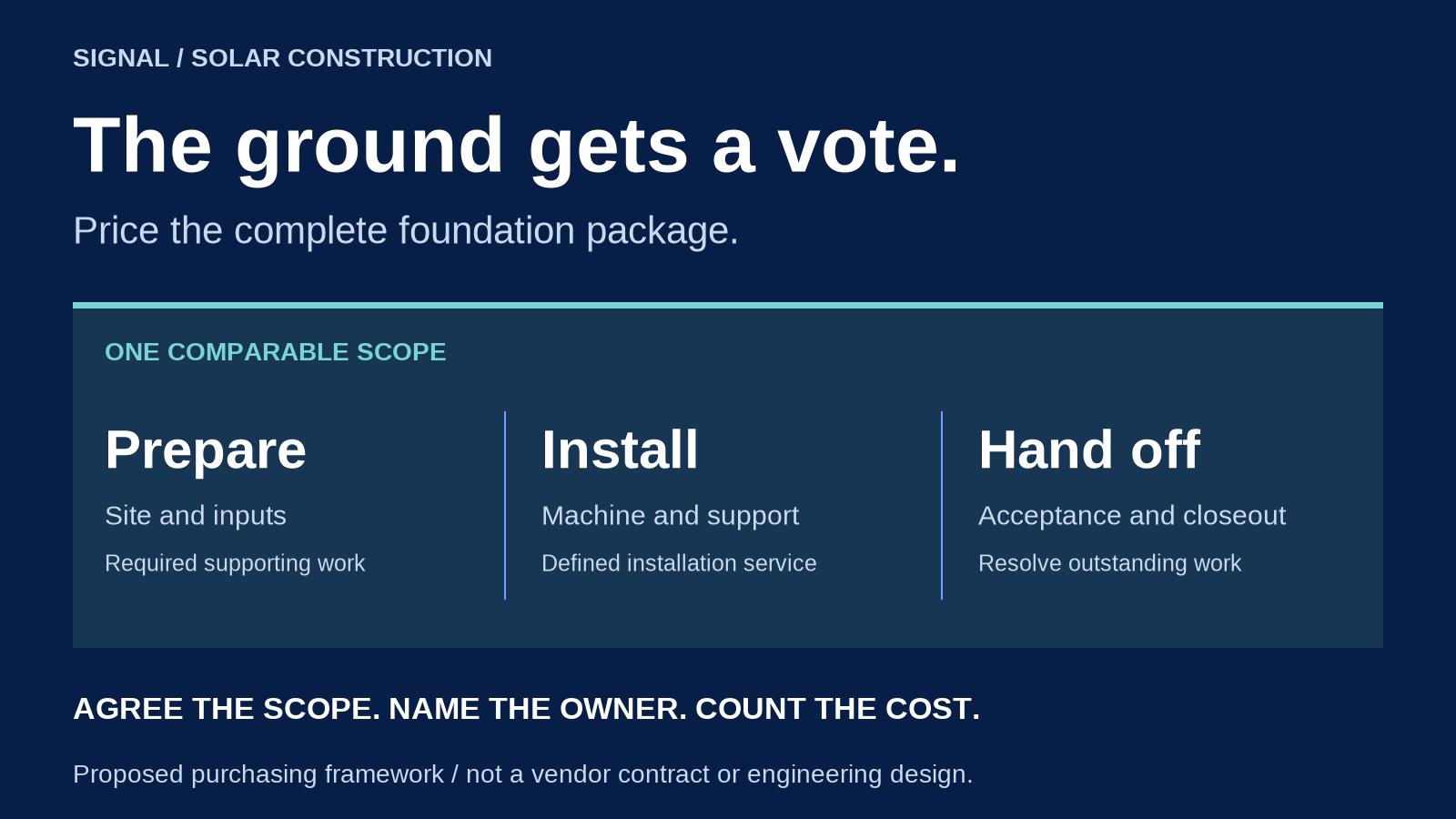
The ground gets a vote.
Robotic solar construction is becoming a real buying decision. Define the complete foundation package before comparing the price per pile.
BLUF
Solar construction is a promising place to automate useful physical work. The buying decision needs a clear boundary around that work. A robot can install piles while people and other equipment prepare the site, supply materials and accept the foundations. For developers and construction contractors, our recommendation is to compare the complete foundation package, with the ground conditions and unfinished tasks stated explicitly.
The opportunity is substantial: machines that help build the infrastructure customers need. A good commercial proposal should make it easy to see what has become repeatable, what remains site-specific and who carries the cost when those two meet.
A field trial with an important condition
Fortescue's February 2026 report describes an August–October 2025 Built Robotics trial at Cloudbreak in Western Australia. Hard ground prevented direct-driving; all pile holes used pre-drilling and cement-stabilised fill. The report says piling quality was acceptable when fill sequencing and hardness were controlled. It also records hardened fill and cracking that required rework. Fortescue trial report, pages 8–11.
The report attributes productivity benefits mainly to simpler logistics and reduced staffing, rather than faster individual pile installation. It could not establish a practical direct cost comparison because of the trial's scale and contractual and methodological differences. Continuous operation in summer extremes remained unproven; direct-driving in Pilbara conditions also required further testing. Those qualifications belong beside the result.
For a buyer, that is useful evidence with a defined scope. It supports a serious project discussion. It leaves the next project's economics to be established.
Find the boundary of the offer
Built Robotics describes its RPD 35 as combining surveying, pile distribution, driving and data collection, paired with an RPS 25 stabilizer. Its current commercial page describes a service model with project-specific per-pile pricing. The loading workflow still calls for a mini excavator and a telehandler. These are manufacturer descriptions; availability and the actual scope require a project proposal. Built Robotics solar piling and FAQ.
That makes a per-pile quote an opening question: what exactly is inside the price?
We would ask the contractor and automation supplier to draw the same boundary around the comparison. Include the specified foundation work, supporting plant and labor, mobilization, supervision, inspection and responsibility for incomplete work. Identify any customer-supplied inputs separately. Keep the project's engineer responsible for foundation requirements and acceptance criteria.
A service model can change how equipment is purchased. It does not, by itself, tell the developer which project obligations have moved to the supplier. A machine rental, an installation service and an accepted foundation package can be three different offers. Clear scope lets a customer compare them without guessing.
Give the estimate an honest denominator
Consider a hypothetical developer comparing two bids. One includes installation after another contractor prepares the work area. The other includes more preparation and closeout. Dividing both headline prices by the same planned pile count would produce neat numbers with different meanings.
We would rebuild the comparison around an agreed block of foundations ready for the next construction stage. Keep the required quality and project conditions consistent. Then show which costs are included, which sit elsewhere in the budget and which remain uncertain. This is our proposed estimating approach, not a reported price comparison or a claim that any supplier omits those costs.
The same discipline applies to a pilot. Agree in advance how the customer will account for accepted work, outstanding work and the resources consumed. A pile awaiting a decision should remain visible as outstanding. Its eventual resolution belongs in the pilot account, even if it happens after the robot leaves.
A cost per accepted foundation is useful only with that context. The customer also needs the completion date and the remaining obligations. A low unit cost on the easy portion of a project cannot answer whether the whole contract will finish within budget.
The spreadsheet does not get to declare the site finished.
Make expansion a commercial decision
Our suggested pilot would answer one question: can this defined service be delivered repeatedly at a price and schedule the customer can use?
The parties should agree which site conditions the trial represents, how results will be accepted and how unresolved work will be priced and completed. The record should include support effort and interruptions as well as successful production. These are proposed evaluation terms, not operating instructions or a substitute for the project's engineering and safety controls.
Expansion would be justified by repeatable accepted work and an explainable cost account across the intended conditions. A promising demonstration that still needs frequent, unpriced specialist intervention would call for a revised service plan before a larger commitment. That is a development question with a budget attached.
For investors, our view is that this is where a useful industrial robotics business becomes distinguishable: it can define its obligation, price the support it needs and show that customers receive the specified result. The most attractive machine still needs a deliverable someone can buy again.
A longer horizon, with the scale clearly marked
A May 2026 preprint from the National Laboratory of the Rockies and Colorado School of Mines explores semi-autonomous assembly of a reduced-scale solar-power prototype under terrestrial conditions. It reports assembly under operator supervision without runtime human intervention, using components adapted for robotic handling. It did not demonstrate robotic pile installation. Standard bolting and torquing were unsupported, and the system lacked perception-based correction. The authors identify substantial work before full-scale field deployment and discuss future lunar applications with additional environmental requirements. This is prototype research, not an off-world deployment. NLR and Mines preprint, evaluation table and future applications.
For us, the interesting ambition is to develop machines and the work they perform together. Components, tools and operating methods can be designed to make an industrial task more repeatable. Research can explore that frontier while a customer contract remains precise about today's demonstrated scope.
That fits VoltSmiths' long-range interest in autonomy extending into the tasks vehicles and their installed equipment perform. Earth-based projects give that ambition a demanding starting point: a customer, a defined job and a result worth paying for.
Sources and further reading
- Fortescue — Pilbara Solar Innovation Hub: Built Robotics trial report, February 27, 2026; field outcomes, limitations and lessons
- Built Robotics — Solar piling: product scope, service model and supporting equipment
- National Laboratory of the Rockies and Colorado School of Mines — Reduced-scale robotic photovoltaic construction pilot, May 2026 preprint