
The mixer is part of the factory
Concrete producers can manage consistency while the load travels. The buying case depends on controlled adjustments, reliable sensors and a load history the receiving crew can use.
BLUF
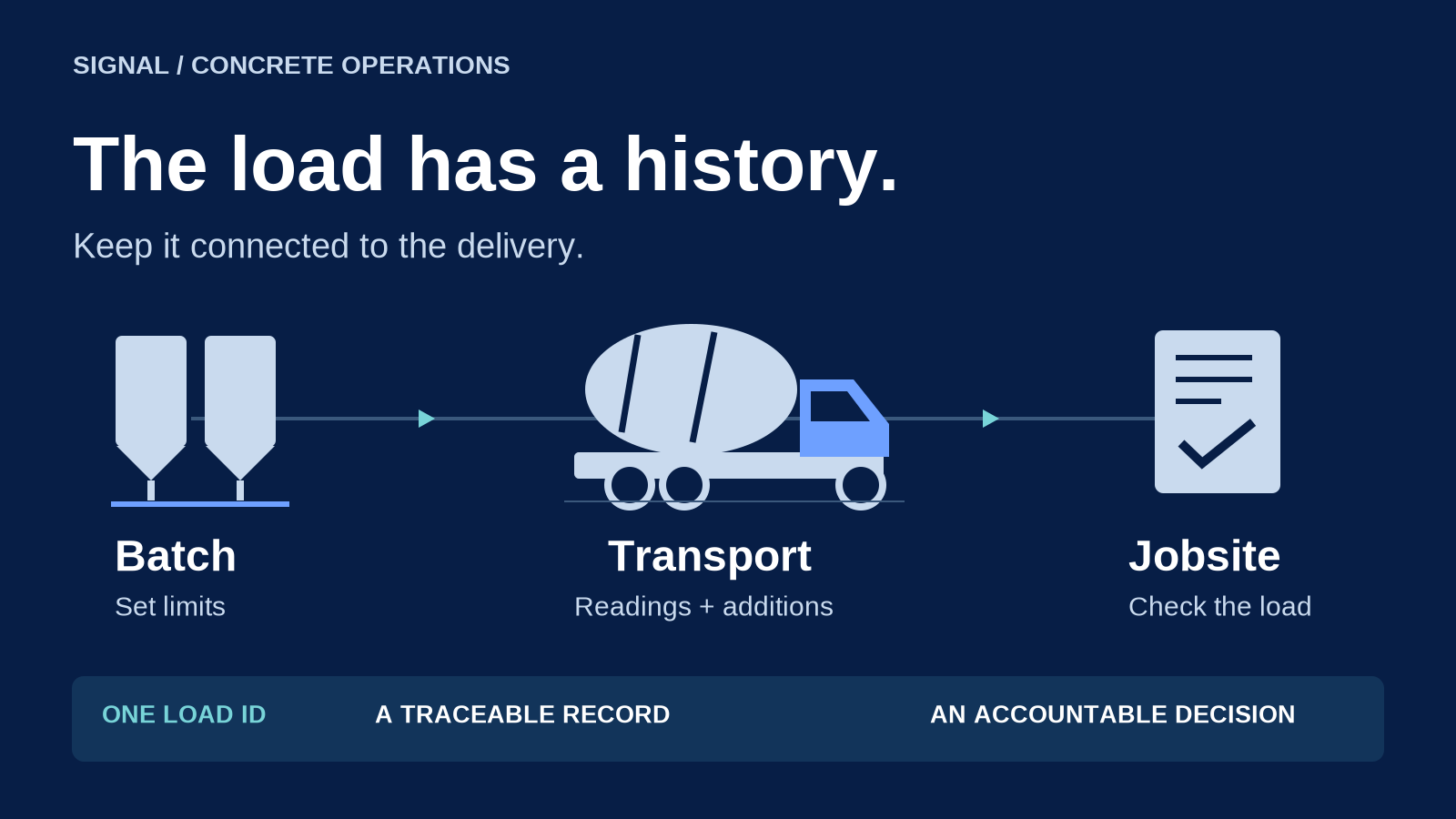
The mixer truck is part of the production process. Its load history should reach the jobsite with it. In-transit concrete systems can monitor material condition and, with the appropriate equipment, adjust consistency during delivery. For ready-mix producers and contractors, the opportunity is better control of what arrives—not just better knowledge of where the truck is.
The buying decision is to connect three things: the intended mixture and permitted adjustments, a trustworthy record of what happened in transit, and the project's acceptance process. That is a practical automation opportunity with a customer waiting at the other end of the chute.
The journey is part of making the product
A concrete delivery has a different objective from moving an inert pallet. The receiving crew needs material it can place under the project's requirements. Location and arrival time matter, but they do not describe the condition of the load.
Verifi's current product description separates measurement from active control. Its Pulse package uses hydraulic-pressure sensors, GPS and a separate drum-mounted temperature and speed sensor. The company lists slump consistency, temperature, drum revolutions and manual water additions among the information provided. With its additional Manage Water + Admixture equipment, Verifi says the system calculates and makes adjustments during transport to maintain the target slump. These are supplier-described capabilities; the measurement package alone should not be mistaken for the full dosing system. Verifi's solution description.
That distinction matters when specifying a fleet upgrade. Seeing a deviation and correcting it are separate functions. Ask which configuration is being quoted, which mixtures it supports, what information it needs from the batch plant and how authorized adjustment limits are applied. A live dashboard does not establish that the truck has the equipment or authority to change the load.
There is also a producer-side example. Heidelberg Materials describes Load Assurance using an in-drum probe, sending information back to the batch operator and displaying load information on the truck's exterior. Its page lists slump, temperature, water added and other operating values. This is the producer's description of its offering, not evidence of universal fleet coverage or independently measured savings. Heidelberg Materials Load Assurance.
The opportunity is a shared view of the material while there is still time to make an informed decision. A dot on a map is useful. It is not a concrete specification.
Treat water as a controlled input
Slump describes concrete consistency; increasing it is not an unlimited license to add water. NRMCA's current CIP 26 guidance explains that additions must respect the applicable slump and water-to-cementitious-materials limits. It warns that excess design mixing water can reduce strength and durability and increase cracking potential. Its discussion of automated systems calls for recording water additions and terminating them at set limits. NRMCA CIP 26, revised 2023.
For a buyer, this makes the adjustment record central to the product. We would ask the producer and supplier to demonstrate how the system identifies the load, receives its permitted limits, accounts for additions and handles an unavailable or conflicting input. Include manual additions in that demonstration. An automated record with an unrecorded hose beside it is an incomplete history.
The actual adjustment procedure belongs to the producer's qualified personnel and the project's requirements. This is a purchasing question about control and traceability, not a dosing recipe. A target on a screen should never become an instruction to keep adding material until the number looks agreeable.
A useful reading and an acceptance decision are different things
NRMCA's CIP 41 describes acceptance testing through representative samples and specified procedures. It covers fresh-concrete properties such as slump, air content, density and temperature, as well as hardened-concrete tests required by the project. It also calls for responsibilities and contingencies to be addressed before construction. NRMCA CIP 41, Acceptance Testing of Concrete.
Our conclusion is that onboard information should strengthen the quality process without silently rewriting it. Agree with the project's responsible parties how sensor records will be used, what tests remain required and who resolves a disagreement. A satisfactory slump reading alone does not establish that every specified property has been met.
Consider a hypothetical load whose onboard reading differs from the jobsite check. The productive response is to retain both records, their timing and the relevant conditions, then follow the agreed investigation and acceptance procedure. Deleting the inconvenient value would make the dashboard cleaner and the evidence worse.
This distinction also helps the contractor. A load record can explain an adjustment and identify who made it. It cannot, by its mere existence, replace the person's authority to accept or hold the material.
The sensor has a working day, too
Measurement equipment needs its own operating discipline. Command Alkon's published COMMANDassurance driver guide describes shift-start probe calibration and conditions for obtaining a slump reading. It also warns that concrete buildup on the probe prevents accurate measurements. These instructions apply to the documented equipment; they are not a universal procedure for every sensing system. Command Alkon driver guide, calibration and probe-positioning sections.
Ask the supplier to demonstrate a normal start of shift, an unavailable reading and the approved cleaning and maintenance process. Establish which indications mean a valid measurement and which mean an exception. A missing result should remain visibly missing rather than being carried forward as if it described the current load.
For fleet managers, installation is only the beginning. Someone must own inspection, calibration, consumables and fault escalation. Include that work in the deployment plan and the price comparison.
Trial the load record from batch to placement
We would start with a bounded set of representative mixes, trucks and delivery conditions, agreed with the producer and contractor. Keep the existing acceptance requirements in force. The trial should establish whether the information is reliable enough to support a useful decision.
| Handoff | Evidence to examine in the trial |
|---|---|
| Batch to truck | Correct load identity, mixture reference, target and permitted adjustments |
| During transport | Time-linked readings, recorded additions, exceptions and data gaps |
| Truck to site team | An accessible load record tied to the actual delivery |
| Acceptance or hold | Required test records, responsible decision-maker and explanation of discrepancies |
| Return to service | Sensor condition, maintenance needs and unresolved faults |
This is our proposed evaluation record, not a list of fields guaranteed by every supplier. Test whether the export is usable by the people who need it, including when systems do not share a common interface. Establish who can retrieve the record later and how long it remains available.
Then evaluate the business result. Compare additional adjustment time, material held or returned, unresolved quality disputes and the completeness of records across comparable work. Retain reasons: a contractor's changed requirement, a sensor fault and a mixture problem should not all become the same rejection statistic. Include hardware, subscriptions, installation, maintenance, training and added quality-control work in the cost.
A successful trial would show useful, repeatable decisions supported by reliable records at an acceptable cost. We would pause expansion if unexplained discrepancies or missing additions prevent the team from trusting the history. No universal savings percentage follows from fitting a sensor.
For VoltSmiths, concrete delivery illustrates an important direction for industrial vehicles: improve the work performed by the machine as well as its movement. The opportunity extends to the material, the operator and the receiving crew. The vehicle earns more value when they can all work from a dependable account of the job.
Sources and further reading
- Verifi — measurement, in-transit control and the equipment distinction
- Heidelberg Materials — Load Assurance and information at the truck
- NRMCA — CIP 26: controlled water additions and automated-system limits
- NRMCA — CIP 41: acceptance testing and responsibilities
- Command Alkon — COMMANDassurance driver guide: calibration, readings and probe care