
The water truck has two jobs.
Haul-road watering shows why industrial autonomy must coordinate movement, equipment and the condition left behind.
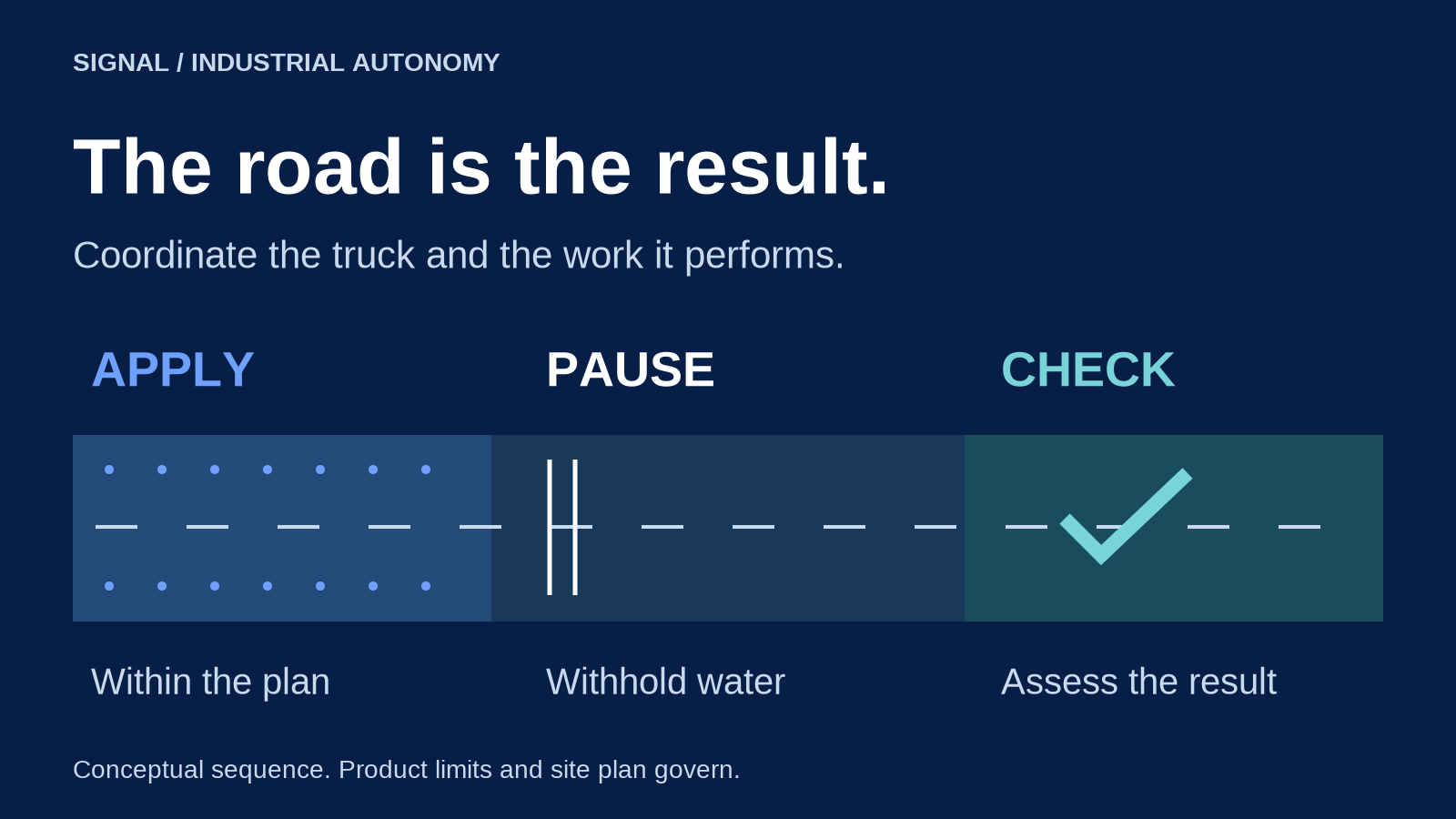
BLUF
A water truck earns its keep through the condition of the road it leaves behind. Automating its route is one part of the opportunity. Coordinating the water delivery with that movement is another. For mine and quarry operators, the useful question is whether the complete system can carry out a site-specific watering plan, handle exceptions and provide evidence that the treatment worked.
Caterpillar's documented water-truck offering makes this a concrete industrial-autonomy example. It also gives buyers a way to separate progress in the working equipment from progress in driving. A quarry considering better watering control does not need to assume that its next decision must be a fully driverless fleet.
Start with the road, not the tank
Imagine a hypothetical haul road with a busy loading area, a ramp and a quieter return section. Treating the entire route as one uniform watering assignment would conceal the operating differences that matter. An empty tank would tell us that water went somewhere. It would not establish that each section received the appropriate treatment.
NIOSH's 2019 industrial-minerals dust-control handbook says watering quantities and intervals depend on site conditions, including the road, traffic and weather. It also discusses the risks of excess water, including slick ramps and road deterioration, and explains how speed-sensitive systems can help distribute water uniformly. This is technical guidance, not a universal watering rate or an endorsement of a particular truck. NIOSH handbook, printed page 348.
That makes the road condition the starting requirement. The site's qualified operations and dust-control teams should define the treatment plan, its restrictions and how performance will be assessed. The technology then needs to execute within those boundaries and make deviations visible.
The tank is a container. Emptying it is not a performance review.
Two kinds of automation can arrive separately
Caterpillar's current Water Solutions page describes automated delivery on operator-driven trucks as well as autonomous watering on the 789 (04) and 789D with MineStar Command. It explicitly makes model availability regional. Its water-delivery system varies flow with truck speed; autonomous movement is a separate part of the integrated offering. These are supplier-described capabilities, with exact configuration and local availability to confirm. Cat Water Solutions.
For an equipment manager, this creates a useful sequence of decisions. First establish whether the existing watering process is delivering the intended result. Then evaluate which control improvement addresses the actual problem. A site might benefit from more consistent application while retaining a driver. Another might be ready to evaluate an autonomous truck within a supported site system.
Those are different projects, with different training, infrastructure and operating responsibilities. Compare them on the work they can reliably support. A water-control upgrade should not be credited with the benefits of an autonomous operation it does not provide.
The broader opportunity is attractive: industrial automation can improve the task before every part of the vehicle's operation is automated. Buyers can ask for a defined improvement and evidence of its value, rather than treating autonomy as one enormous yes-or-no purchase.
The pause is part of the job
Caterpillar's March 2025 announcement describes the 789D integrating truck, tank, Water Delivery System and MineStar. It says delivery stops below a site-set minimum watering speed and when the tank is empty; the system also checks software compatibility and reports onboard failures to MineStar. The documented operating boundary matters: tasks such as front water-cannon use require switching to staffed mode. These are manufacturer statements about that system, not proof of performance at every site. Cat's 789D announcement.
For our hypothetical route, a buying demonstration should show more than a successful spray pass. Ask the supplier to explain the approved behavior when the truck slows, watering is suspended, a required input is unavailable or the assignment changes. Establish which events are recorded and who resolves an incomplete task.
We would keep two questions separate: may the truck move here, and may it apply water here now? That is our proposed way to examine the job, not a claim about a particular software interface. The site plan and product instructions determine the actual controls.
Use a supplier-approved demonstration or simulation for exceptions. There is no value in improvising a fault on an active haul road. What matters is that the people responsible can explain the response, identify unfinished work and follow the supported recovery process.
Measure delivery and the result separately
A useful evaluation needs two records. One describes the treatment: where and when it occurred, the intended application and the available evidence of water delivered. The other describes the road afterward, using the site's agreed assessment methods.
Our proposed trial record is deliberately specific:
| Part of the job | Evidence to examine |
|---|---|
| Assigned treatment | Road section, current plan and applicable restrictions |
| Actual application | Time, coverage and delivered-water information the system can substantiate |
| Interruption | Where treatment paused, why, and what remains unfinished |
| Road result | Site-defined dust-control and road-condition assessment |
| Resources | Water, refill activity, truck time and human support used |
These are evaluation questions, not guaranteed data fields in the cited products. Ask how the supplier measures or estimates each value. A command to dispense water and a measurement of water delivered deserve different labels.
Compare representative road sections and shifts, recording changes in traffic, weather and road maintenance. If the trial uses less water, check whether it still achieves the agreed result. If it treats more road, check whether the added work is needed. Both comparisons are stronger than celebrating a larger tank, more laps or a lower consumption figure in isolation.
A visibly wet surface alone is not a substitute for the site's dust assessment. Keep the established monitoring and operating requirements in place. This article proposes a purchasing evaluation; it does not prescribe application settings or establish regulatory compliance.
Build the business case around a repeatable task
For the operator, the potential value is a more dependable watering process with resources directed where they are useful. That benefit needs local evidence. Count installation, support, control-system upkeep, refill arrangements and the people still needed for supervision, inspection and tasks outside the automated scope.
For investors, our view is that this illustrates a commercially useful unit of progress: one recurring industrial task made easier to specify, execute and verify. The integration opportunity includes the vehicle, installed equipment, operating plan and service responsibility. A credible supplier must be able to price and support that complete obligation.
This is also the direction VoltSmiths intends to pursue over time: autonomy extending into the work industrial vehicles and their equipment perform. Haul-road watering offers a clear lesson. Define the result, coordinate movement with the tool, and retain a practical way to confirm the job was done.
Sources and further reading
- NIOSH — Dust Control Handbook for Industrial Minerals Mining and Processing, second edition, 2019; MSHA-hosted copy, printed page 348
- Caterpillar — Current Water Solutions lineup, automation distinctions and regional availability
- Caterpillar — March 2025 789D autonomous water-truck announcement and operating boundaries