
The whole shift is the product
Tesla Semi offers a useful lesson for industrial automation: build the operating system around the work, as well as the technology inside the truck.
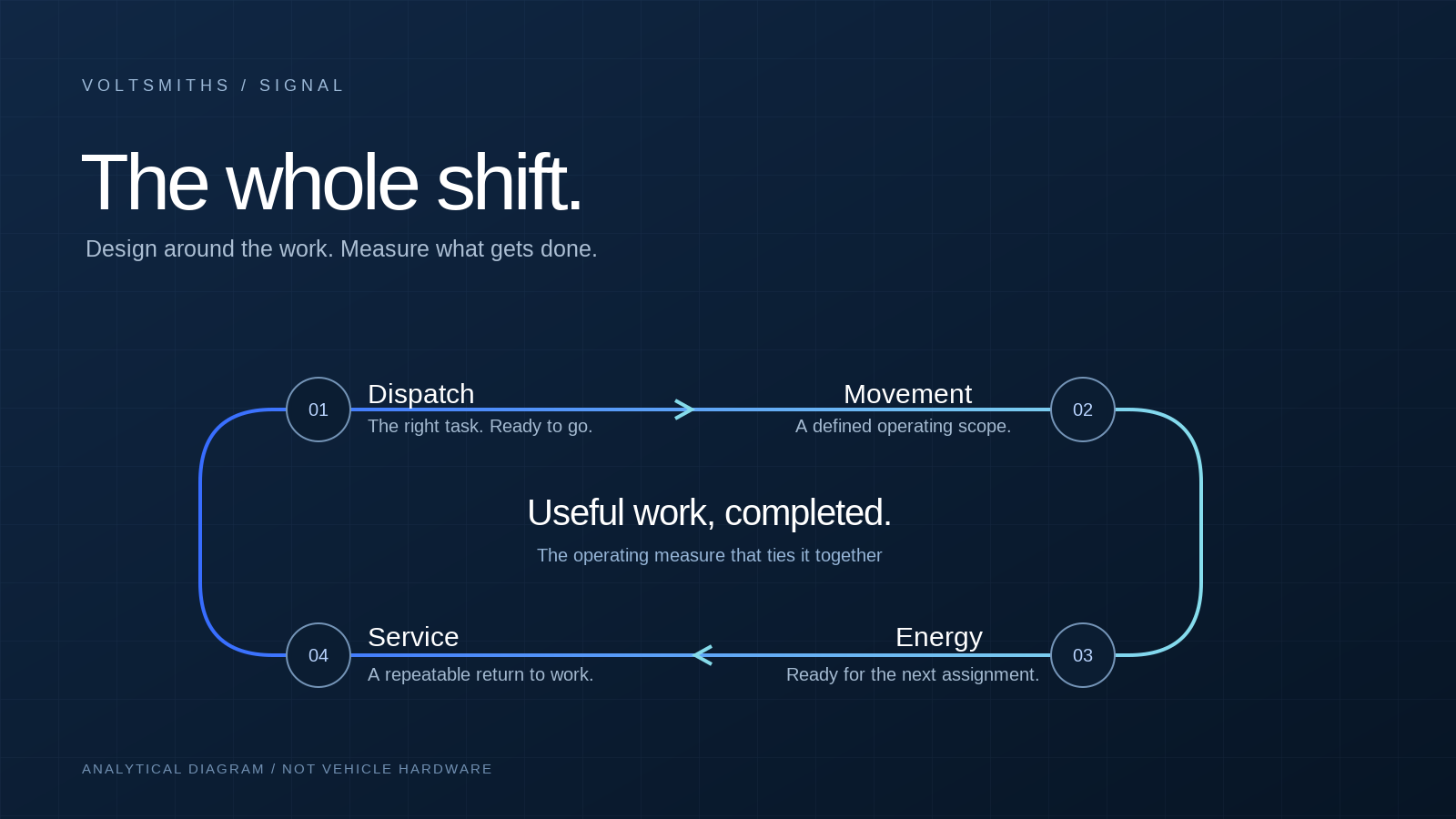
BLUF
A work vehicle earns its place by completing useful work. Tesla’s published Semi charging guidance brings the truck, driver, fleet account and charging stop into one operating picture. The opportunity for industrial automation is to apply that same whole-shift thinking: define the job, engineer the handoffs, and measure completed work before expanding the operating scope.
The charging stop is part of the product
Tesla says a Megacharger can provide up to 1.2 MW and recover up to 60% of Semi’s range in 30 minutes. Its guidance also explains that charging performance depends on battery conditions and other use of the charger. Those are stated capabilities and conditions, not a promise that every fleet stop takes half an hour. Tesla’s Semi charging guidance is the primary source.
The more interesting detail for an operator may be the surrounding workflow. Tesla describes fleet-managed charge limits, driver assignment, vehicle enrollment and centralized billing. These are mundane details with unusually good leverage. A truck that arrives at the right charger with the right account and an appropriate charge target is easier to dispatch than one whose operating plan ends at the charging socket.
That is our interpretation of the system Tesla describes: the vehicle and the operating process belong in the same design conversation. A fast charger creates an opportunity. A well-planned shift turns that opportunity into useful capacity.
A fleet cannot deliver a spreadsheet. Someone still has to make Tuesday work.
Start with the job you can describe precisely
Consider an illustrative industrial service route: a truck carries parts from a yard to several work areas and returns between assignments. There is no claimed customer or measured performance behind this example. It is a way to make the design problem concrete.
The first question is what a completed assignment means. Delivering a part to the correct staging area is a different job from finding a crew that moved during the shift. Crossing a public road introduces different conditions from circulating inside a controlled yard. Towing, carrying an elevated load or operating with a front attachment changes the vehicle configuration that needs to be evaluated.
Before automating that route, we would write down the boundaries: approved paths, load and attachment configurations, visibility conditions, pedestrian interactions, operator responsibilities and the process for an exception. A narrow first assignment can still be commercially useful. It also gives engineering a clear target instead of a moving collection of expectations.
The ambition is a product that can grow. The starting point should be a job that can be tested.
Measure the handoffs, not just the miles
For a pilot, we would use a small operating scorecard alongside the driving data. These are proposed evaluation measures, not published Tesla requirements or VoltSmiths test results.
| Part of the shift | Evidence to collect | Decision it informs |
|---|---|---|
| Dispatch | Requested task, actual departure and reasons for delay | Can the crew depend on the vehicle when work starts? |
| Movement | Completed routes, interventions and operating conditions | Which duties fit the validated operating scope? |
| Energy | Arrival state, replenishment time and departure readiness | Does the energy plan support the assigned work? |
| Service | Faults, diagnosis time, parts and return to duty | Can support keep the vehicle useful? |
| Completion | Successful assignments and exceptions per shift | Is the complete operation improving? |
The denominator matters. A low intervention count means little if the truck only ran an easy route for a short period. A more useful record includes the number of assignments, the exposure to relevant conditions and the reasons work was interrupted.
Similarly, a vehicle can cover fewer miles and still deliver more value if it reduces waiting between useful tasks. That is a hypothesis to test with the operator’s baseline, not a universal claim about automation. Measure the operation before the trial, keep the comparison meaningful, and retain the inconvenient days in the data.
Build support while engineering the vehicle
Tesla’s first-quarter 2026 filing describes the need to expand delivery, service and charging infrastructure alongside vehicle production. It also discusses dedicated operating infrastructure for its Robotaxi business, including cleaning, maintenance and fleet management. These are different vehicle programs, but the filing makes the wider operating system visible. Tesla Q1 2026 Form 10-Q, management discussion.
The lesson we draw for industrial vehicles is practical: prepare the build process and the support process while integration is underway. Decide how an installation will be inspected, how its configuration will be recorded, what a technician needs to diagnose a fault, and who owns the return-to-service decision.
That work can begin before every feature is finished. Teams can develop installation instructions against the current design, identify tooling, exercise service access and revise those details as the platform matures. The output is a shorter path from a validated design to a repeatable installation. Treating these as parallel engineering tasks is how we would pursue speed without turning the first customer into the production-development department.
Keep the first release explicit
Tesla’s FSD (Supervised) guidance distinguishes advanced driver assistance from autonomy: the driver must actively supervise, and the features do not make the vehicle autonomous. Tesla’s FSD (Supervised) support page states that boundary directly. It describes Tesla vehicles; it does not establish availability or suitability for another manufacturer’s platform.
For VoltSmiths, supervised movement is the intended first product direction. Additional driverless capabilities and work functions belong to subsequent, separately validated operating scopes. Public discussion of Tesla technology does not establish a partnership, license or approved integration.
That separation gives a team something concrete to build and an operator something concrete to evaluate. A first release should explain who is responsible for driving, which tasks it supports, the conditions under which it can be used and what happens when those conditions change. Future capability is an engineering agenda, not a substitute for those answers.
VoltSmiths is building its approach around a defined duty, vehicle integration, field evidence and production readiness developed together. We want useful products into service quickly, with a clear basis for the next release. The work is the point. The truck has to earn its place in it.