
The work happens between machines.
Harvest automation shows how two vehicles can coordinate a useful task. Buyers should evaluate the machine pair, the material transfer and the return of control together.
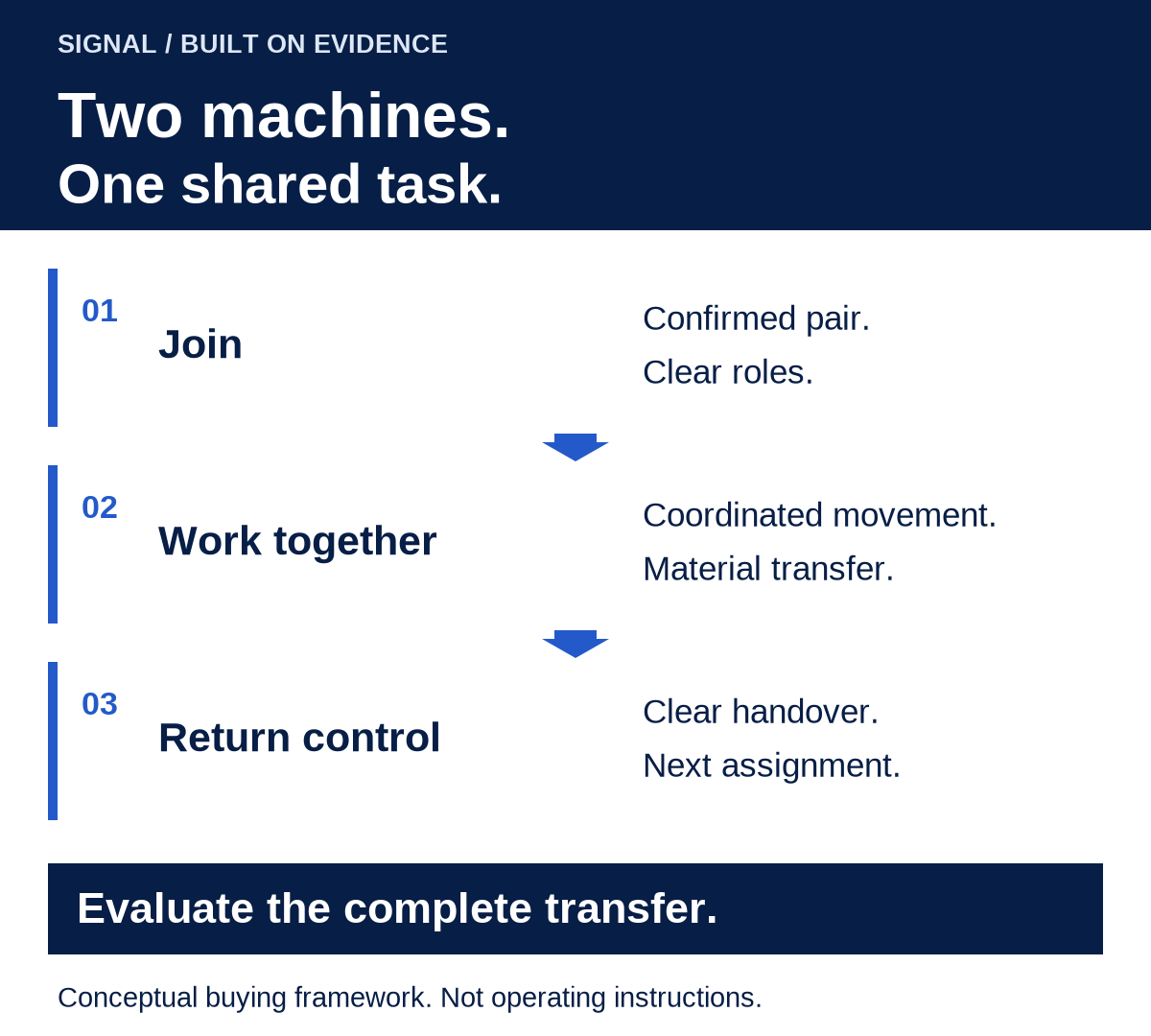
BLUF
A combine and a grain cart show where useful industrial automation can begin: two machines coordinating one job. Published systems already synchronize their movement during unloading, while operators remain part of the operation. The buying opportunity is a better transfer of material. Evaluate the supported machine pair, the work it completes and the transitions into and out of automation.
A moving handoff with a clear purpose
During unloading on the go, the cart must stay in a useful position relative to the combine while grain moves between them. That makes the relationship between the machines part of the work. A tractor following a path accurately is only one piece of the assignment.
Case IH's August 12, 2026 explanation of Raven Cart Automation describes radio-connected coordination between the combine and grain-cart tractor. The cart operator engages the system after a request; automation brings the cart toward an established synchronization point. The combine operator can then adjust its position for filling. The account ends with the cart operator disengaging and continuing to the unloading point. Case IH's operating overview.
This is a bounded, operator-mediated task. The overview describes two operators and a defined period of coordinated movement. It does not establish an unattended harvest operation or tell a buyer that any tractor and combine will work together. Equipment-specific instructions and supplier confirmation still govern the proposed pairing.
The useful idea is that a repetitive interaction can become a product in its own right. A farm buys an improvement to unloading, with a beginning, a working period and an end.
Matching movement and placing material are separate capabilities
John Deere's Machine Sync help describes a follower maintaining a position relative to a leader, using compatible equipment and receiver information. Correct machine and implement measurements and offsets are part of setup. Machine Sync technical help.
That provides a foundation for coordinated motion. Deciding where the incoming grain should land is an additional job.
In its March 17, 2025 Australian announcement for model-year 2026 combines, Deere described an auger-mounted auto-unload camera that senses grain fill level and sends forward/backward positioning commands to the tractor. Supporting hardware and software are part of the feature. The announcement also described an upgrade route for older combines; it is not a compatibility list or confirmation of availability for a particular U.S. machine. Deere's model-year 2026 announcement.
Our interpretation is a useful distinction for buyers: relative-position control keeps the machines working together; sensing the material can help determine how that position should change. Ask which part of the task a quoted package actually performs. A camera, a guidance function and a complete filling function are different entries on a specification.
Make the transitions visible
Deere's separate status guidance distinguishes readiness, acquiring the follower's position and tracking the leader. A ready follower still requires operator engagement. Machine Sync status descriptions.
Those distinctions deserve time in a demonstration. We would ask the supplier to explain what each operator sees, when coordinated control begins, what remains under human control and how normal control is restored. Include the supported response to an interrupted transfer. An impressive middle does not excuse an unclear beginning or end.
The operating limits matter here. Deere's cited help warns that Machine Sync does not detect or avoid obstacles or bystanders, and does not bring the follower to a complete stop. It requires alert operators able to take control. It also documents tracking limitations on sharp curves and direction changes. These statements concern that documented system; they should not be generalized into instructions for another product. Machine Sync operating cautions.
For a buyer, the practical consequence is to keep responsibilities attached to each stage. Use trained personnel and the actual equipment's approved procedures. Procurement analysis can identify questions; it cannot supply the operating procedure for a machine pair it has never inspected.
Buy the pairing you will actually run
Before signing for a package, we would put the proposed combine, tractor, cart, displays, receivers, communication equipment, software and licenses on one configuration sheet. Have the supplier confirm that combination, including relevant model years and installed versions. The sheet should also identify setup, calibration, training and service responsibilities.
Then consider the spare equipment. If the usual tractor is unavailable, which substitute can support the same task? What setup must be repeated when a display or implement changes? Does the crew have an approved manual operating option while service restores the automation? These are questions for the actual supplier, not claims that every package supports interchangeable machinery.
The purchase price buys equipment. The operating plan has to make a working pair available when the crop is ready. A feature cannot synchronize with the tractor that stayed in the shed.
A useful acceptance discussion could look like this:
| Stage | Question for the proposed configuration | Evidence to retain |
|---|---|---|
| Join | Can the crew establish the correct pairing and supported working position? | Setup record, engagement time and unsuccessful attempts |
| Work together | Does the system perform the quoted positioning or filling function? | Completed transfers, operator corrections and observed material placement |
| Return to ordinary duty | Do operators understand disengagement and the next assignment? | Demonstrated handover and documented exceptions |
| Change equipment | Can the intended spare configuration be used? | Supplier confirmation and required setup or restrictions |
This is our proposed buying framework, not a manufacturer's test protocol.
Count accepted transfers
For a field evaluation, compare representative transfers with the existing method under comparable crop, terrain, cart and crew conditions. Record how often the combine waits specifically for unloading, how long joining takes, the work completed during coordinated movement and the interruptions. Keep failed engagements in the record. They still happened, even if the promotional video would prefer a different take.
Assess material placement and any observed spillage alongside elapsed time. Faster synchronization is not the desired result if the transfer itself becomes less reliable. Equally, a good unloading result does not prove that truck availability or the receiving facility can accept more output. Keep the benefit attributed to the part of the operation that actually changed.
The commercial calculation should include the cost of equipping both sides, introduction work, recurring licenses, support and downtime. Reduced coordination effort may be valuable without removing either operator. These sources describe capabilities and operating boundaries; they do not establish a universal savings figure for another farm.
For VoltSmiths, coordinated work is a useful direction beyond driving alone. A vehicle may eventually need to work with another machine, an attachment or a receiving station. Harvest automation offers a concrete design lesson: define the shared task, make control responsibilities visible and judge the result where the material changes hands.